



Rental solutions for companies
Technology upgrades made easy: the advantage of hardware rental
In today’s fast-paced technology world, staying up-to-date is crucial. However, companies and individuals often face the challenge of selecting the right hardware and upgrading it when necessary. This is where hardware rental offers a flexible and cost-effective solution. In this article, we will show the advantage of hardware rental and how easy upgrades and exchange processes are through rental models and why hardware rental is an attractive alternative to buying.
Upgrade options: Hardware rental vs. hardware purchase
When it comes to technology upgrades, companies and individuals often face the decision: buy or rent? Both options have their advantages and disadvantages, but in today’s world, where technology is rapidly evolving, hardware rental is becoming increasingly important.
When you buy hardware, you are generally tied to the purchased technology in the long term. An upgrade often means that old devices have to be sold or disposed of, which can be both time-consuming and costly. In addition, purchased hardware quickly loses value, which can lead to further financial losses when reselling.
In contrast, hardware rental offers significantly greater flexibility. Rental agreements can be structured so that regular upgrades are already integrated. This ensures that the technology used always remains up-to-date without the need for additional investments. When an upgrade is needed, the rental provider replaces the old hardware with new hardware – quickly and easily.
Comparison: Purchase vs. Rental
| Criterion | Hardware purchase | Hardware rental |
|---|---|---|
| Initial costs | High acquisition costs | Low to no acquisition costs |
| Depreciation | High depreciation over time | No depreciation for the renter |
| Flexibility | Low, long-term commitment to devices | High, adaptation to current needs |
| Upgrade options | Complex and expensive | Simple and included in the rental agreement |
| Technological standard | Risk of becoming obsolete quickly | Always up to date |
| Maintenance and support | Own responsibility or extra costs | Often included in the rental agreement |
Simple upgrades and replacement processes thanks to rental models
A significant advantage of hardware rental lies in the easy handling of upgrades and exchange processes. In a rental model, these processes are usually regulated in the contract and do not cause any additional effort for the renter. But what does the process look like in concrete terms?
Let’s imagine a company rents laptops for its employees. After two years, it turns out that new software updates require more computing power and the existing devices are reaching their limits. Instead of having to invest in new hardware, the company can contact the rental provider. As a rule, the provider offers two options: either the existing devices are upgraded, if possible, or they are exchanged for newer models.
This exchange process runs smoothly, as the rental provider not only delivers the new devices, but often also takes over the installation and transfer of data. This not only saves time, but also minimizes the risk of data loss and other technical problems.
In addition, this flexibility in hardware selection allows the renter to react more quickly to new market trends and adapt their technology landscape without much effort. This is particularly advantageous in dynamic industries where technological progress plays a crucial role. In addition, any accessories rented without any problems, without having to buy them and then gather dust in boxes after use.
Cost control and budget planning through hardware rental
Another decisive advantage of hardware rental is the improved cost control and simple budget planning. Companies often face the challenge of raising large sums for the purchase of new hardware all at once, which can put a strain on the budget. In addition, future maintenance and repair costs must be included in the calculation, which are difficult to predict.
In contrast, hardware rental offers a transparent and predictable cost structure. The rental rates are usually paid monthly or annually and often include services such as maintenance, support and even insurance. This fixed calculation enables companies to plan their IT budgets precisely and avoid unexpected expenses.
By avoiding high initial investments, more financial leeway remains for other important areas of the company, such as research and development or marketing. The risk of depreciation is also eliminated, as the responsibility for the resale or disposal of the hardware lies with the rental provider.
Another advantage: Flexible adjustments are possible in many rental agreements. If, for example, the company expands and needs more devices such as smartphones, these can be added easily and cost-effectively. Conversely, devices that are no longer needed can simply be returned, which enables optimal adaptation to current needs.
This flexibility combined with cost control makes hardware rental particularly attractive for companies of all sizes, from start-ups to large corporations.
FAQ: Frequently asked questions about hardware rental
- What happens to the rented hardware at the end of the rental contract?
At the end of the rental agreement, the hardware is usually returned to the provider. The provider takes over the professional preparation or recycling of the devices. There is often also the option of extending the rental agreement or renting new, updated hardware.
- Is hardware rental more expensive than buying?
The monthly costs of hardware rental may appear higher compared to a one-time purchase. However, renting eliminates the high initial investments as well as the costs for maintenance, support and upgrades, which often makes renting cheaper in the long term.
- Can I customize the rented hardware?
Many rental providers offer the option of adapting the hardware to the specific needs of the company. Depending on the contract, individual configurations, upgrades or additional services can be agreed upon.
- How quickly can I switch to new technology if necessary?
One of the biggest advantages of hardware rental is flexibility. If required, the rented hardware can be exchanged quickly and easily for newer models, often without additional costs. This enables companies to always work with the latest technology.
Conclusion: Flexibility and future-proofing through hardware rental
Hardware rental offers numerous advantages that go beyond pure cost savings. It enables companies to react flexibly to technological changes, keep their IT infrastructure up to date and at the same time keep costs under control. Especially in times of rapid technological progress and growing environmental awareness, hardware rental proves to be a future-proof solution. Companies not only benefit from easy handling and planning, but also actively contribute to sustainability.
Read more
New iPads 2024: What companies should know
New iPads 2024: Innovation and performance in perfection - Discover the highlights of the latest
Aug

Renting technology instead of buying in companies
Renting technology instead of buying: Flexible solutions for companies - save costs and always be
Nov

Top IT Trends 2024: What Companies should Know
Top IT Trends 2024: Discover the technologies that drive your company forward—from AI to cloud
Jul
Read more - You may also be interested in
Would you like to delve deeper into the topic or discover similar content? Below, we have compiled three additional articles for you that are thematically related to this article. These may also be relevant and interesting for your company.
Technology trends
Shadow AI in everyday office life: risks, rules and safe alternatives for companies (intended for event/project teams & temporary devices)
Shadow AI in everyday office life: Recognize 2026 risks & safe alternatives for event and

Advisor
Deepfake fraud & social engineering: protective measures for event staff, promotion teams and rental equipment
Deepfake fraud & social engineering 2025: How to protect events, promotion teams & rental equipment.
Feb

Technology trends
NIS2 compact for event IT & hardware rental: What companies should implement organizationally & technically now
NIS2 Directive 2025: How event IT & hardware rental companies are implementing organizational & technical
Feb
Technology trends
VR glasses 2025/2026 for trade fairs & events: device overview and selection criteria
VR glasses for trade fairs 2025/2026: The latest models & top criteria. How to choose
Feb

Sustainability
Renting hardware instead of buying: Environmental benefits, capacity utilization and carbon footprint
Why rent 2025 hardware? Reduce CO₂, optimize capacity utilization & benefit from sustainable IT solutions
Feb
Technology trends
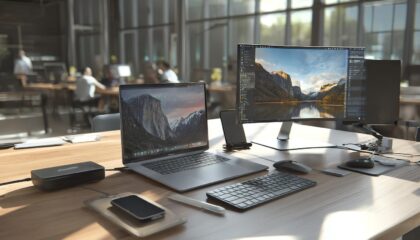
USB-C/docking stations & “one cable for everything”: efficient workstation setups for events and pop-up offices
One cable for everything: How USB-C docking stations enable efficient workstation setups at events &
Feb

Sustainability
Sustainable logistics in IT: reusable transport boxes, return shipping without packaging waste & secure delivery
Sustainable IT logistics 2025: reusable transport boxes, waste-free returns & secure delivery. Modern solutions for
Jan

Sustainability
Circular economy through rental/leasing instead of buying: CO₂, costs and flexibility in comparison
Sustainable & flexible: circular economy through rental/leasing instead of buying! CO₂ reduction, costs & agility
Jan