




Rental solutions for companies
Fiber to the room (adhesive fiber optics) for exhibition stands & pop-ups: plan, install and remove temporary high-speed cabling without leaving any residue
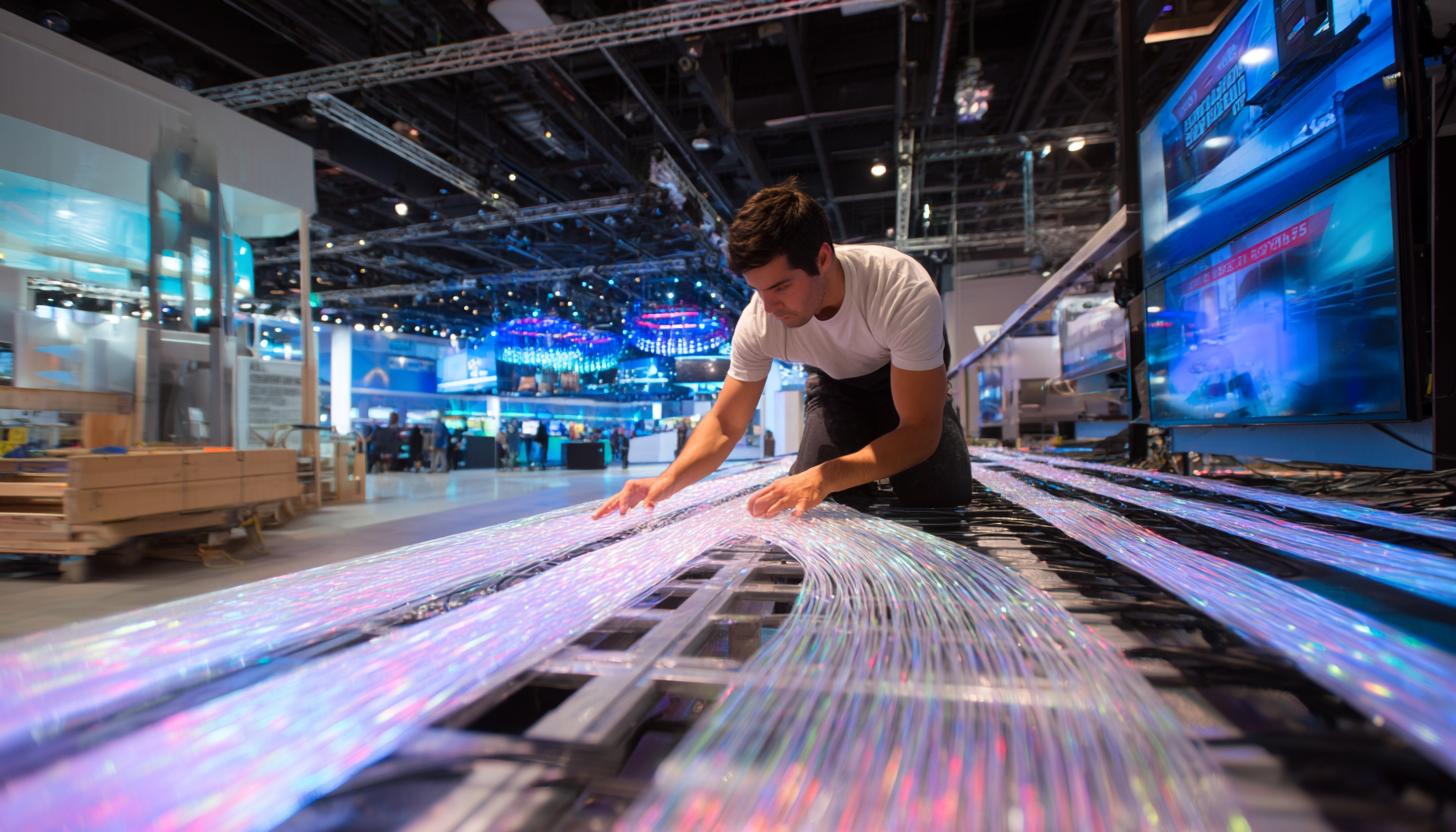
Fiber to the room (adhesive fiber optics) for exhibition stands & pop-ups: plan, install and remove temporary high-speed cabling without leaving any residue
At trade fairs, roadshows, pop-up stores and temporary event spaces, the demands on network infrastructure have been increasing significantly for years. Where a single internet connection used to suffice for the cash register and a few emails, stable high-speed connections are now required for live demos, streaming, digital product presentations, cloud-based POS systems, lead capture, video calls, digital signage, interactive touchpoints and parallel fleets of devices. This is precisely where fiber to the room with so-called bonding fiber gains importance.
Anyone looking for fiber optic exhibition stand rental often first thinks of a classic, permanent fiber optic connection. For temporary application scenarios, however, it is not only the access itself that is decisive, but above all the question of how the fiber optics can be distributed within halls, event areas, congress areas or retail locations quickly, securely, visually discreetly and without leaving any residue. This is precisely why adhesive fiber optics are interesting: they enable temporary, high-performance and comparatively elegant cabling directly to the point of use in the room.
This article is about how companies and agencies can professionally plan temporary fiber optic solutions for trade fairs and pop-ups, the advantages of adhesive fiber optics compared to traditional temporary solutions, what to look out for during installation and dismantling and how the solution can be ideally combined with rented IT and event technology.
Why high-speed networks are business-critical at trade fairs and pop-ups today
Temporary spaces are no longer “incidental installations”. Many B2B companies operate complete digital sales environments at trade fairs. Products are configured live in the cloud, CRM data is recorded directly, hybrid appointments are held via video and content is played out synchronously on multiple displays. There is also Wi-Fi for teams, rented tablets for consulting, smartphones for rent for mobile processes, scanners, digital cash registers, visitor management and, not infrequently, real-time connections to company systems.
The problem: mobile networks are often overloaded at major events, classic copper cabling quickly reaches its limits with long distances and demanding applications, and improvised cable runs are risky both visually and organizationally. Temporary fiber optic cabling creates a clear advantage here, especially if it can be implemented without extensive structural interventions.
Adhesive glass fiber addresses precisely this requirement. The fiber is guided along walls, edges, skirting boards, door frames or suitable surfaces and mounted using a special adhesive layer. This allows a connection to be established in individual rooms, standing areas or functional zones without the need for conventional civil engineering or permanent installation measures.
What is adhesive glass fiber and what does fiber to the room mean in temporary use?
In simple terms, fiber to the room means the fiber optic connection directly to the place where bandwidth is actually needed – i.e. not just to the building or the central technology room, but to the respective meeting room, back office area, presentation point or exhibition stand.
Adhesive glass fiber is a particularly slim form of interior cabling. It was developed for applications in which a fiber is to be applied inconspicuously to surfaces. This is interesting for temporary event and trade fair installations because the cable can be laid discreetly and can be removed again without leaving any residue in many cases if it is installed professionally. However, it is always crucial to check the substrate, the suitability of the adhesive and the removal conditions on site.
Typical locations are:
- Exhibition halls with temporary stands
- Congress areas and conference rooms
- Pop-up stores in shopping centers or city center locations
- Showrooms and launch areas
- Temporary press and hospitality areas
- Back office, control and streaming zones at events
Fiber optic exhibition stand rental: Why rental and temporary infrastructure are an ideal match
Especially in the B2B environment, rental often makes more economic sense than buying. This applies not only to smartphones, tablets, laptops, displays, scanners, Wi-Fi solutions and receipt printers, but also to network components and temporary connectivity concepts. If you want to rent fiber optics at your trade fair stand, you usually need an overall concept rather than a single product.
Typically, a professional solution consists of several components: Connection at the event location, distribution to the stand or individual zones, active network such as switches and routers, WLAN infrastructure, end devices as well as support and dismantling. It is particularly attractive for companies if everything is planned and provided from a single source. This results in fewer interfaces, less coordination effort and significantly higher operational reliability.
The rental model also makes it easier to accommodate changes at short notice. If additional demo stations, more cash desks, a streaming setup or additional workstations are added, the required technology can be flexibly expanded. This is a real advantage at trade fairs because stand concepts often change shortly before set-up.
Advantages of adhesive glass fiber over standard temporary solutions
In practice, you still often see copper cables, wild transitions, improvised routing or a heavy reliance on Wi-Fi and mobile communications at events. This sometimes works, but quickly becomes problematic with higher loads and professional demands. Temporary fiber optic cabling with adhesive fiber optics offers several advantages here:
| Solution | Advantages | Typical limits |
|---|---|---|
| Adhesive glass fiber | High bandwidth, low susceptibility to interference, unobtrusive installation, suitable for longer distances, orderly temporary installation | Requires professional planning, suitable surfaces and clean installation |
| Copper Ethernet | Widely used, familiar handling, practical for short distances | Larger cable cross-section, visually more conspicuous, more limited paths and higher susceptibility to unclean temporary solutions |
| Pure WLAN | Quick to set up, flexible for mobile devices | Dependent on radio environment, hall utilization and sources of interference; often not sufficient for critical applications alone |
| Mobile radio / 5G | Can be used without local lines, good as a backup | Fluctuating at trade fairs with high utilization; upload, latency and stability cannot always be planned |
The combination is particularly relevant here: fiber optics as a stable basis, active network technology for distribution and professionally planned WLAN for mobile devices. The result is an overall system that offers both high performance and flexibility.
How to plan fiber to the room correctly for exhibition stands and pop-ups
A good temporary fiber optic installation starts long before the construction. If you only order the bandwidth but do not consider the actual applications, you risk bottlenecks despite the supposedly fast line. Planning should therefore always be based on the actual use cases.
Important questions are: How many devices are online at the same time? Which applications are critical? Are there video streaming, live switching or upload-intensive processes? Does sensitive data need to be transmitted? Where exactly are counters, demo areas, displays, cash registers, storage, back office and meeting zones located? Which routes may be used for cable routing? Which hall and organizer specifications apply?
A professional concept takes into account not only the exhibition stand itself, but also the entire infrastructure from the transfer point to the end device. In the case of pop-up areas, it should also be noted that surfaces, rental properties and shopfitting often place special demands on the mounting and subsequent dismantling.
The following planning logic has proven itself:
- Record requirements: Applications, users, devices, bandwidth, priorities.
- Check location: Transfer points, cable routing, material compatibility, fire protection, access options.
- Define network design: Fiber optic paths, active components, segmentation, WLAN coverage, backup.
- Bundle technology: Combine routers, switches, access points, tablets rental, smartphones rental, cash registers, displays and accessories from one rental solution.
- Define assembly and dismantling: Time frame, responsibilities, labeling, test operation and documented dismantling.
Installation in practice: fast, clean and suitable for indoor use
Precision is what counts most when it comes to implementation. Adhesive glass fiber should be routed along sensible lines so that it is protected, unobtrusive and traceable. Typical routes are wall connections, edges or other defined surfaces. Depending on the layout of the exhibition stand, the route can be routed to technical counters, meeting rooms, media walls or control areas.
It is important to coordinate with stand construction, the organizer and, if necessary, hall technology. Many trades run in parallel, especially at large events: stand construction, electrics, AV technology, IT, branding and furnishings. Proper coordination prevents cable routes from being obstructed, damaged or unintentionally overbuilt.
Professional installation also includes measuring and testing the connection. Even if the installation is only used for a few days, the route must be reliably documented. This is important in order to quickly localize sources of error during operation and make adjustments at short notice if necessary.
Residue-free removal: what really counts when dismantling
A major argument for adhesive glass fiber in temporary environments is the possibility of clean dismantling. Especially in rented areas, on exhibition grounds or in high-quality retail environments, it is crucial that no permanent traces are left behind after the event. However, the same applies here: “residue-free” is not automatic, but the result of the right choice of materials, suitable substrates and professional dismantling.
Surfaces should be checked before use, such as paintwork, coated furniture, sensitive wall materials, glass, metal surfaces or textured substrates. Temperature, humidity and dwell time of the installation are equally important. A qualified service provider will test the suitability in advance or coordinate the design with the venue’s specifications.
During dismantling, the pipes are detached in defined steps, materials are separated and surfaces are checked. This reduces the risk of damage and speeds up the handover to the hall operator or landlord. This point is particularly important for companies with a tight dismantling timeframe, as unnecessary rework can quickly become expensive.
Which technology can be ideally combined with temporary fiber optics
The connection alone does not make a successful trade fair appearance. A resilient, high-performance setup is only created in combination with the right rental technology. For many B2B projects, an integrated model comprising connectivity, network technology and mobile devices is recommended.
Typical additions are rented tablets for lead capture and consulting, such as an Apple iPad Air 5 10.9 inch for high-quality consulting situations, rented smartphones for team communication, for example an iPhone 16e for mobile processes, notebooks for rent for presentation and CRM access, such as an HP ZBook Firefly 15 G8 for demanding business applications, receipt printers and scanners for POS scenarios, digital signage displays, access points for visitor and internal WLAN as well as routers and switches for structured distribution.
Specialized devices are also particularly useful for interactive product presentations or digital check-in processes. For touch applications at the stand, for example, an iiyama ProLite TF1515MC-B2 touch display can be used. A DS4208 barcode scanner is ideal for checkout, goods flow or lead capture. If several consultation points need to be flexibly equipped, different tablets can also be rented, such as a Galaxy Tab S8 Plus for Android-based applications.
This results in a clear advantage for the customer: instead of coordinating different trades individually, a central technology partner can provide the infrastructure in a coordinated manner. This reduces friction and increases the chance that everything will run reliably on the first day of the trade fair.
Don’t forget security, stability and backup
The more digital the trade fair presentation, the more important issues such as reliability and IT security become. A fiber optic line is a strong building block, but is no substitute for a well thought-out security and operating concept. Networks in temporary areas should be segmented, for example for internal devices, cash registers, presentation technology, guest Wi-Fi and production systems. This allows risks to be better controlled and critical applications to be prioritized.
Backup scenarios are also useful. Even with a good primary connection, an additional mobile network or second access solution can help you remain operational in the event of a fault. Especially for product launches, press events, live streaming or lead-intensive sales fairs, this redundancy is often worthwhile for economic reasons alone.
Equally relevant: Monitoring during the event. Anyone running important applications on the stand should not wait until guests are faced with a malfunctioning touchpoint before reacting. Professional rental and service concepts ideally include support, replacement devices and clear escalation channels.
For which companies is fiber optics at the trade fair stand particularly worthwhile?
In principle, all companies with a digitally supported trade fair concept benefit. However, fiber optics at the exhibition stand for rental is particularly useful for exhibitors with a high level of technical dependency. These include software and SaaS providers, industrial companies with real-time demos, retail and POS concepts, financial and consulting companies with security-critical applications, media and streaming setups and brands with a highly interactive visitor experience.
The solution also shows its strengths in pop-up stores. If a high-quality sales or presentation space is to be set up at short notice, a temporary fiber optic connection in combination with rented hardware can often be implemented much faster and more flexibly than a classic permanent infrastructure.
Cost-effectiveness: Why temporary professional solutions are often cheaper than improvisation
At first glance, improvised network solutions sometimes seem cheaper. In practice, however, the actual costs are often caused by outages, delays, additional coordination, technical support under time pressure and an unprofessional presentation to customers. If demos falter, payment processes fail or leads cannot be captured, the damage is usually significantly higher than the price of a properly planned infrastructure.
A rental model creates costing certainty here. Companies receive exactly the technology they need for the respective period, including the appropriate configuration and often also services. This is particularly attractive for recurring trade fairs, roadshows and changing pop-up concepts, as the infrastructure remains scalable without tying up capital in rarely used hardware.
Conclusion
Fiber to the room with adhesive glass fiber is an extremely interesting solution for exhibition stands, pop-up spaces and temporary event environments when high bandwidth, a clean look, fast implementation and controllable dismantling are required. Instead of relying on insecure temporary solutions or overloaded wireless solutions, companies receive a professional, high-performance infrastructure directly where it is needed.
Anyone looking for fiber optic exhibition stand rental should not only consider the Internet access, but the entire setup: Cable routes, distribution, WLAN, active network technology, end devices, security, support and dismantling. The solution is particularly strong when connectivity and rented technology such as tablets, smartphones, laptops, scanners, displays and routers come from a coordinated overall concept.
For B2B companies, agencies and event organizers, this means less risk, better performance and a trade fair or pop-up appearance that looks just as professional as the brand itself. If you are planning temporary high-speed cabling with suitable rental technology for your next project, it is worth making an early inquiry – especially if several classes of equipment, stand zones or safety-critical applications are to work together.
FAQ
What is the advantage of adhesive glass fiber on an exhibition stand?
Adhesive fiber optics enable inconspicuous and high-performance fiber optic cabling within temporary areas. It is particularly suitable where high bandwidth is required but no permanent installation is desired or possible.
Is it possible to rent fiber optics for an exhibition stand?
Yes, in the professional B2B environment, both the connectivity itself and the associated infrastructure, such as routers, switches, WLAN, tablets, smartphones, notebooks, scanners or displays, can be rented. The decisive factor is an overall concept tailored to the application.
Can adhesive glass fiber really be removed without leaving any residue?
With suitable surfaces and professional installation and removal, residue-free dismantling is possible in many cases. However, it is still important to check the substrate beforehand, especially in high-quality or sensitive rental areas.
Isn’t WLAN or 5G also sufficient for trade fairs?
Sometimes yes for simple applications, but often not for business-critical processes. Wireless networks can fluctuate greatly at trade fairs. A wired fiber optic base ensures greater stability, while WLAN and mobile radio can be a useful addition or serve as a backup.
For which applications is fiber optics particularly useful at the trade fair stand?
For example, for live streaming, product demos with cloud connection, multiple parallel displays, digital checkouts, CRM lead capture, video conferencing, control room setups, data-intensive presentations and sophisticated visitor interactions.
When should planning begin?
As early as possible. Venue specifications, availability, cable routes, coordination of trades and hardware requirements must be coordinated in good time, especially for trade fair projects. This reduces risks during construction and significantly improves operational reliability.
Read more - You may also be interested in
Would you like to delve deeper into the topic or discover similar content? Below, we have compiled three additional articles for you that are thematically related to this article. These may also be relevant and interesting for your company.
Technology trends
Apple vs. Windows in event use: which devices are better suited for which use cases
Apple or Windows for events in 2026? We show strengths, weaknesses & areas of application
Apr
Advisor
Phishing & social engineering at trade fairs: Typical attacks and protective measures for teams on site
Phishing & social engineering at trade fairs 2026: Recognize typical attacks, protect your team &
Mar

Advisor
Windows 11 rollout & end of Windows 10 support (2026): What companies should consider now when renting and leasing devices for projects, events and rollouts
Windows 11 rollout & end of support for Windows 10: What companies need to consider
Mar
Rental solutions for companies
Fiber to the room (adhesive fiber optics) for exhibition stands & pop-ups: plan, install and remove temporary high-speed cabling without leaving any residue
Discover the advantages of adhesive glass fiber for your exhibition stand: high-speed, flexible, residue-free &
Mar

Technology trends
Shadow AI in everyday office life: risks, rules and safe alternatives for companies (intended for event/project teams & temporary devices)
Shadow AI in everyday office life: Recognize 2026 risks & safe alternatives for event and
Mar

Rental solutions for companies
Plan event IT accessories correctly: stands, brackets, adapters & cables without stress
Plan your event IT accessories stress-free! Tips on stands, brackets, cables & more. Rent cleverly
Mar

Advisor
Deepfake fraud & social engineering: protective measures for event staff, promotion teams and rental equipment
Deepfake fraud & social engineering 2025: How to protect events, promotion teams & rental equipment.
Feb

Technology trends
NIS2 compact for event IT & hardware rental: What companies should implement organizationally & technically now
NIS2 Directive 2025: How event IT & hardware rental companies are implementing organizational & technical
Feb