



Technology trends
Future of work: Which technologies are shaping the office of tomorrow?
Future of work: Which technologies are shaping the office of tomorrow?
The advancing digitalization and social change have sustainably changed the way we work in recent years. In 2025, it is clear: The future of work is digital, flexible and technology-driven. Technologies play a central role, especially in the B2B environment and in the equipment of modern offices. Companies face the challenge of making their working environments future-proof in order to promote innovation and secure competitive advantages.
Which technologies dominate the office of the future? How do they change the work processes – and which mobile devices play a key role? In this article, we provide insights into the most important trends around the future of work and show how modern technology can enrich your working world today.
1. The most important technology trends in the modern office (2025)
The office of the future is more digital, mobile and intelligent than ever before. The following technology trends are currently particularly in focus:
- Artificial intelligence (AI) and automation: AI optimizes workflows, takes over repetitive tasks and supports teams in decision-making.
- Cloud-based Collaboration Tools: Tools such as Microsoft Teams, Google Workspace or Notion enable location-independent collaboration in real time.
- Mobile First & Device-as-a-Service: Flexibility is achieved through mobile devices such as high-performance computers, business-suitable iPads and the latest Samsung Galaxy Smartphones – often efficiently provided via rental models.
- Cybersecurity solutions: Security software, Zero Trust concepts and Remote Management protect devices and sensitive data.
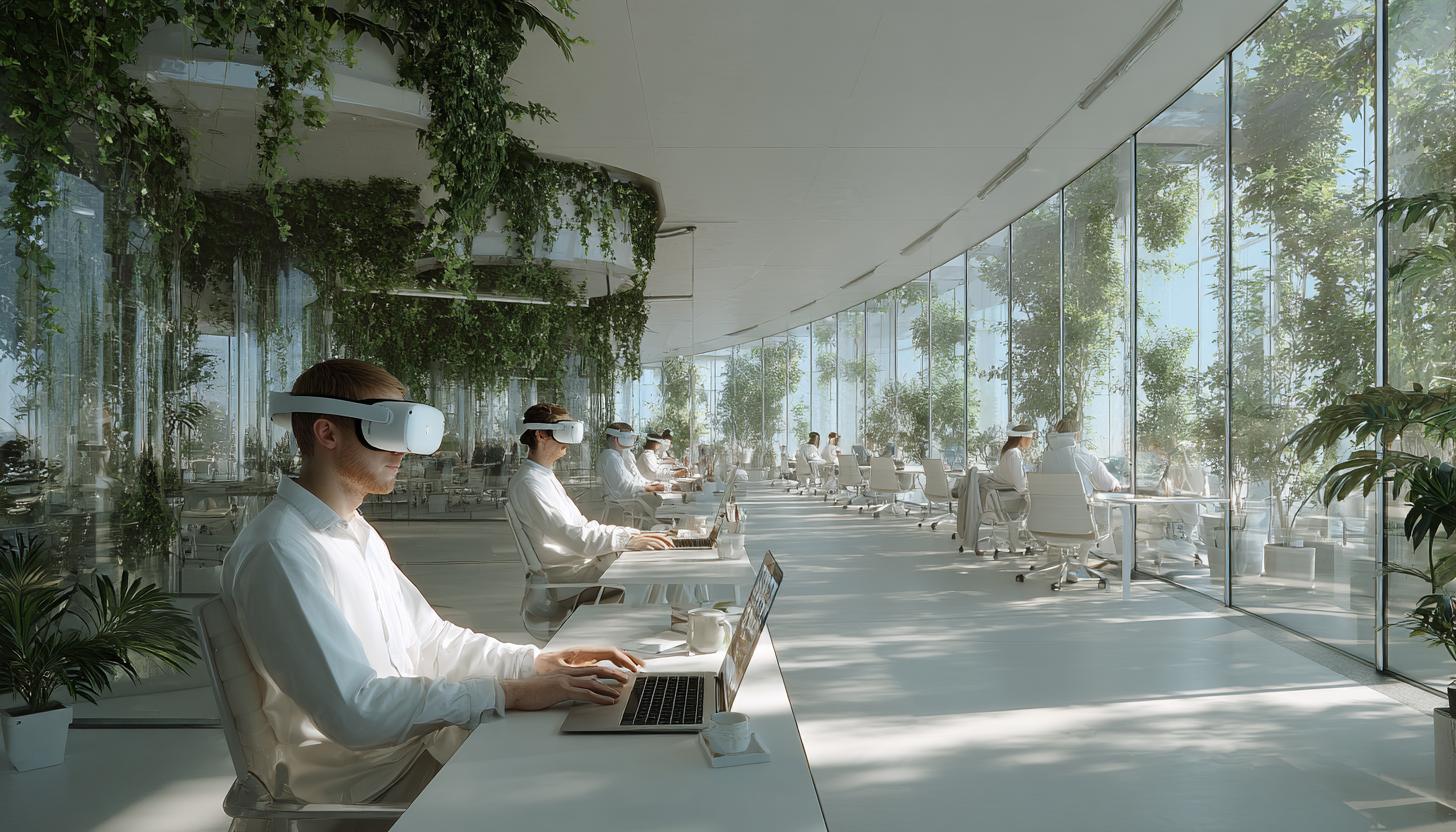
- Virtual Reality (VR) and Augmented Reality (AR): New forms of working and training via immersive technologies are becoming reality. Devices such as the Meta VR glasses enable innovative meeting and training experiences.
- 5G & WiFi 6E: Faster and more stable connection for unlimited mobile productivity.
These technologies are no longer a vision – they are reality and are already changing the daily work of many companies today. The challenge now lies in integrating these innovations strategically.
2. Hybrid working as the new normal
A central keyword of the future of work is “hybrid working”. This refers to the flexible combination of office and remote work. Studies show that the fixed office workplace is increasingly dissolving and being replaced by hot-desking models or home office solutions. Employees today expect mobile devices that allow them to work seamlessly and securely from anywhere.
The use of modern devices is essential here. Notebooks, tablets and smartphones enable teams to access all data and tools at any time. Convertibles, which can be used as both a laptop and a tablet, are particularly popular in hybrid scenarios – such as the versatile HP Omnibook Ultra Flip or the Microsoft Surface Pro 10, which enables maximum flexibility for every work style.
3. Device-as-a-Service (DaaS): Efficient device provision
More and more companies are relying on Device-as-a-Service models (DaaS) to make their IT infrastructure more flexible, scalable and cost-efficient. Instead of making high initial investments, mobile devices such as laptops, iPads or smartphones can be obtained via rental models – including services such as installation, maintenance or exchange.
Advantages of DaaS for companies at a glance:
| Advantage | Description |
|---|---|
| Cost efficiency | Predictable monthly costs instead of high investments |
| Flexibility | Scalable rental models adapt to the company’s needs |
| Always up-to-date technology | Access to the latest devices without outdated hardware, e.g. with the new iPad Pro M4 (13 inch) or the Samsung Galaxy S25 Ultra. |
| Service & Support | Technical support, replacement devices and maintenance included |
| Sustainability | Reuse and professional recycling promote sustainability |
Would you like to convert your company to a future-proof model? Our platform offers modern devices for rent for every company size – ask us for a non-binding offer.
4. Sustainability in the digital office
Sustainability is one of the biggest drivers in the technology industry. Companies are increasingly focusing on green IT strategies. Energy efficiency also plays a major role in the selection of mobile devices. In addition, more and more providers are paying attention to CO₂-neutral supply chains, long-lasting batteries and recyclable housing materials.
It is worth not buying devices anymore, but replacing them regularly via smart rental models – this ensures that resources are used optimally and electronic waste is reduced. Flexible rental models for devices such as the Meta Quest 3S VR-Headset are also a step towards sustainable corporate IT.
5. New workplace design through technology
The office of tomorrow is not only technically, but also physically different. Rooms are flexible, meeting rooms are equipped with smart screens or Virtual Collaboration Tools. Digital whiteboards, room occupancy sensors and intelligent lighting systems support a modern working environment.
Especially in the mobile sector, modern tablets with pen functions, powerful notebooks with video conferencing optimization or robust smartphones for field service are becoming increasingly important. For example, if you want to use a state-of-the-art service device, you can benefit from the latest iPads such as the iPad Pro M4 (13 inch) or use the Samsung Galaxy S25 Ultra for field service.
6. Artificial intelligence as an assistance system
AI systems support task prioritization, scheduling and information retrieval. Generative AI such as chatbots or writing assistants help to create content or make customer service faster and more targeted.
Increasingly, AI solutions are also being integrated into mobile devices, e.g. for intelligent voice control or the optimization of battery life. Companies should test early on how AI tools such as Microsoft Copilot or Google Duet AI can improve their way of working – ideally on powerful hybrid devices such as the Surface Pro 10.
7. Security & data protection in focus
The increase in remote work and mobile devices requires secure solutions. Modern Mobile Device Management systems (MDM), encrypted connections and biometric authentication are standard today. Companies must strengthen technical and organizational measures – especially with BYOD (Bring Your Own Device) strategies.
Recommendation: Rental devices with a central management system offer security and control without restricting mobility. Rely on reliably configurable business computers with scalable protection.
8. Recommendations for the selection of mobile devices
The following device types have proven themselves for modern working environments:
- Ultrabooks: Lightweight, powerful, often with long battery life – ideal for hybrid teams, e.g. the HP Omnibook Ultra Flip.
- Convertibles: Combination of laptop and tablet for maximum flexibility, such as the Surface Pro 10.
- Business-Tablets: Compact, with input pen and keyboard dock for presentations and on-the-go work, e.g. the popular iPad Pro M4 (13 inch).
- 5G-Smartphones: Powerful communication devices such as the Samsung Galaxy S25 Ultra with app integration and secure company control.
Are you planning to equip your company with the right technology? Our rental solutions combine the latest hardware with professional service – take a look at our range of computers, iPads or Samsung Galaxy Smartphones or request a personal consultation.
FAQ – Frequently asked questions about the future of work
Which technologies are particularly important in everyday office life in 2025?
Artificial intelligence, cloud tools, mobile devices, Device-as-a-Service models, cybersecurity systems, 5G and collaboration platforms play a central role in modern working.
How does my company benefit from rental equipment?
With rental solutions, you receive the latest technology on a monthly basis – including support, maintenance and updates. You remain flexible, save investment costs and receive service from a single source. Discover the advantages directly with our computer solutions for rent.
Are rental devices secure with regard to data protection?
Yes. The devices are pre-configured with security standards such as MDM systems, device management and encrypted backup solutions. We are also happy to advise you individually on your requirements.
Which devices are ideal for hybrid working?
Convertibles such as the Surface Pro 10, business tablets such as the iPad Pro M4 (13 inch) and ultrabooks such as the HP Omnibook Ultra Flip enable flexible working at home, on the go or in the office – ideal with cloud access and video conferencing functionality.
Conclusion: The future starts now – redesign your working world
The future of work is determined by digitalization, AI and flexible models. Companies that adapt to these changes benefit not only from higher productivity and satisfaction in the team, but also from sustainable, modern structures.
Mobile devices are the backbone of flexible working models. With rental solutions and a strong technology partner at your side, you can ensure that your IT infrastructure is always up to date. Take a look at our diverse range of computers, iPads, Samsung Galaxy Smartphones and Meta VR glasses for rent – we are happy to advise you on your way to the office of tomorrow.
Read more - You may also be interested in
Would you like to delve deeper into the topic or discover similar content? Below, we have compiled three additional articles for you that are thematically related to this article. These may also be relevant and interesting for your company.
Technology trends
Shadow AI in everyday office life: risks, rules and safe alternatives for companies (intended for event/project teams & temporary devices)
Shadow AI in everyday office life: Recognize 2026 risks & safe alternatives for event and
Advisor
Deepfake fraud & social engineering: protective measures for event staff, promotion teams and rental equipment
Deepfake fraud & social engineering 2025: How to protect events, promotion teams & rental equipment.
Feb
Technology trends
NIS2 compact for event IT & hardware rental: What companies should implement organizationally & technically now
NIS2 Directive 2025: How event IT & hardware rental companies are implementing organizational & technical
Feb
Technology trends
VR glasses 2025/2026 for trade fairs & events: device overview and selection criteria
VR glasses for trade fairs 2025/2026: The latest models & top criteria. How to choose
Feb
Sustainability
Renting hardware instead of buying: Environmental benefits, capacity utilization and carbon footprint
Why rent 2025 hardware? Reduce CO₂, optimize capacity utilization & benefit from sustainable IT solutions
Feb
Technology trends
USB-C/docking stations & “one cable for everything”: efficient workstation setups for events and pop-up offices
One cable for everything: How USB-C docking stations enable efficient workstation setups at events &
Feb

Sustainability
Sustainable logistics in IT: reusable transport boxes, return shipping without packaging waste & secure delivery
Sustainable IT logistics 2025: reusable transport boxes, waste-free returns & secure delivery. Modern solutions for
Jan
Sustainability
Circular economy through rental/leasing instead of buying: CO₂, costs and flexibility in comparison
Sustainable & flexible: circular economy through rental/leasing instead of buying! CO₂ reduction, costs & agility
Jan