





Leasing Solutions for Businesses
Which VR Headset Is the Best in 2026? – The Ultimate Comparison for Companies Looking for Virtual Reality Hardware Rental
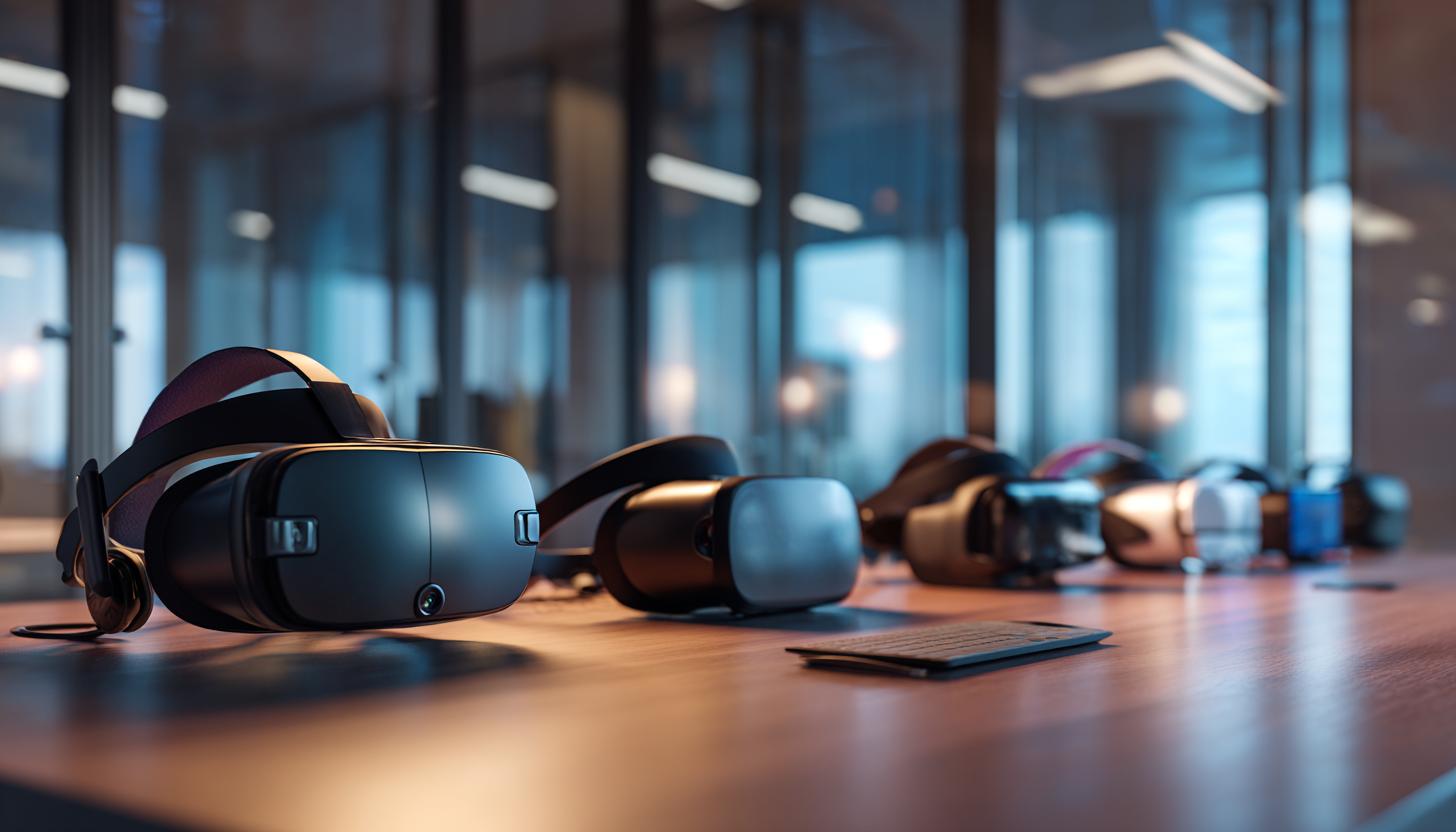
As of June 24, 2026 – Which VR headset is the best? There is no single model that can answer this question. Different requirements apply to gaming, training, product presentations, trade shows, mixed reality applications, and professional visualizations.
A good VR headset comparison should therefore do more than just compare technical specifications. Other important factors include comfort, image quality, tracking, controllers, battery life, app selection, setup, hygiene, scalability, and the specific use case. A VR headset for an event must meet different requirements than one intended for professional product visualization or intensive training.
In this guide, we compare current and relevant models such as the Meta Quest 3, the Meta Quest 3S, the PICO 4, the PICO 4 Ultra Enterprise, the Apple Vision Pro, and—as a special case—the Ray-Ban Meta. The focus is on determining which solution is best suited for which use case.
Which VR headset is the best?
The best VR headset is always the one that suits your intended use. For many companies, a wireless standalone VR headset is the most practical option. It works without an external PC, is quick to set up, and is well-suited for training sessions, events, presentations, or simple immersive applications.
For particularly high-quality mixed-reality experiences, spatial collaboration, or premium presentations, however, a headset like the Apple Vision Pro is a good option. For large groups of participants or budget-conscious projects, a Meta Quest 3S or PICO 4 may be a better choice. For more technically demanding business or mixed-reality setups, the PICO 4 Ultra Enterprise is a good option.
The Ray-Ban Meta doesn’t exactly fall into the same headset category, but it can be an exciting smart glasses solution for certain projects. It isn’t suitable for immersive VR experiences, but it is ideal for hands-free photo and video capture, POV content, audio, Meta AI, and testing smart glasses.
The most important question, therefore, is not simply: Which VR headset is the best? A better question is: Which VR, mixed reality, or smart glasses solution is best suited for the specific purpose?
VR Headset Comparison: The Most Important Criteria
When comparing VR headsets, several factors should be considered. Resolution affects how sharply text, menus, 3D objects, and virtual spaces are displayed. High image sharpness is particularly important for training, product visualizations, and applications with a lot of detail.
Lenses also play a major role. Pancake lenses typically allow for a more compact design and provide good clarity across a larger portion of the field of view. Fresnel lenses are less expensive, but may cause more noticeable light reflections or edge blur for some users.
Tracking and controls determine how natural the VR experience feels. Controller tracking is reliable and intuitive for many applications. Hand tracking, eye tracking, or mixed-reality sensors can offer additional benefits in professional setups.
For businesses, other important factors include ease of management, quick setup, hygiene, accessories, battery life, and the ability to configure multiple devices identically. Especially at trade shows, training sessions, or with large groups, VR headsets should not only be technically robust but also easy to manage from an organizational standpoint.
VR, Mixed Reality, or Smart Glasses?
Not every device in the broader XR space serves the same purpose. Traditional VR headsets display immersive virtual worlds and are suitable for training, simulations, gaming, virtual tours, or interactive product demos. Mixed-reality headsets combine digital content with the real-world environment. Smart glasses like the Ray-Ban Meta, on the other hand, are significantly lighter and more suitable for everyday use, but they do not offer an immersive VR environment.
This distinction is important for businesses. Anyone planning a virtual training session or a 3D simulation will need VR or mixed-reality glasses. Those who want to capture hands-free footage, create event content, produce social media clips, document products, or conduct AI-powered smart glasses tests can consider the Ray-Ban Meta as a complementary solution.
Meta Quest 3: The Powerful All-Around Performer
The Meta Quest 3 remains one of the most powerful all-around VR headsets. It combines high resolution, robust mixed reality capabilities, pancake lenses, a wide selection of apps, and wireless functionality. This makes it ideal for events, training sessions, presentations, gaming, product demos, and many business applications.
Standalone use is particularly convenient. The glasses do not require an external PC and can be used right away. This is a clear advantage for businesses that need to quickly deploy multiple devices or use them at different locations.
The Meta Quest 3 is therefore an excellent choice if you’re looking for a flexible, modern, and versatile headset. While it may not be the best solution in every specific area, it offers a very good overall package.
Meta Quest 3S: A Good Choice for Larger Groups
The Meta Quest 3S is particularly appealing when you need multiple devices and budget is a major consideration. It offers cutting-edge performance and mixed-reality features, but has fewer features than the Quest 3.
The Quest 3S can be a great choice for large-scale training sessions, workshops, onboarding projects, or simple VR experiences. However, if you need the highest image quality, the best lenses, or maximum sharpness, the Quest 3 remains the better choice.
The Quest 3S is therefore particularly well-suited for scalable deployments where solid performance, ease of use, and a wide range of available devices are more important than the most high-end features.
PICO 4: Lightweight, well-balanced, and sturdy
The PICO 4 is a wireless, standalone VR headset featuring high resolution, pancake lenses, and a comfortable fit. It is well-suited for training, simple simulations, product presentations, and VR experiences where comfort and solid image quality are important.
Compared to the Meta Quest 3, the selection of apps and content is an important consideration, depending on the application. For standardized business content or pre-built applications, however, the PICO 4 may still be a suitable solution.
The PICO 4 is particularly appealing to businesses looking for a comfortable headset for repeatable VR experiences, provided the necessary software is available on the platform.
PICO 4 Ultra Enterprise: For Modern Mixed Reality Projects
The PICO 4 Ultra Enterprise is geared more toward professional applications. It features advanced mixed-reality sensors, the Snapdragon XR2 Gen 2, 12 GB of RAM, Wi-Fi 7, two 32-MP color see-through cameras, and an iToF depth-sensing camera. This makes it particularly well-suited for more demanding business scenarios.
The headset is of interest to companies that want to use mixed reality, product visualization, training scenarios, spatial content, or interactive presentations in a professional setting. Its enterprise focus can also help with management and standardized setups.
Anyone looking for a modern alternative to the Meta Quest 3 and focusing more on professional MR applications should include the PICO 4 Ultra Enterprise in their comparison.
Apple Vision Pro: A Premium Solution for Spatial Work
The Apple Vision Pro is not a traditional VR headset in the strict sense, but rather a very high-quality mixed-reality headset designed for spatial work, presentations, media, product visualization, and immersive applications. It features an extremely high-resolution Micro-OLED display, eye and hand tracking, visionOS, and very intuitive controls.
The Apple Vision Pro excels particularly in high-quality presentations, design reviews, spatial media, collaborative scenarios, and premium demos. For simple group events or large numbers of participants, however, it is generally too high-end and costly.
The Apple Vision Pro is therefore the best choice when maximum display quality, intuitive operation, and a particularly high-end feel are the top priorities. For scalable training programs or traditional group VR applications, the Meta Quest or PICO are often more practical.
Ray-Ban Meta: Smart Glasses Instead of Traditional VR Headsets
The Ray-Ban Meta is not a traditional VR headset. It does not display an immersive virtual environment and therefore does not replace the Meta Quest 3, PICO 4, or Apple Vision Pro. Instead, it is a smart AI headset with a camera, open-ear audio, and voice control.
The Ray-Ban Meta may still be of interest to businesses. It is particularly well-suited for events, content production, POV footage, product documentation, social media formats, trade show coverage, or testing smart glasses applications.
Anyone planning a VR training session, an immersive 3D experience, or a mixed reality application should opt for traditional VR or MR headsets. For those who want to try out hands-free recording, audio, and smart assistance in everyday life, the Ray-Ban Meta is a great choice.
Comparison Chart: Which VR Headset Is Best for Which Use?
The following table provides a concise overview of the most important models. The Ray-Ban Meta has been deliberately classified as a special case, as it is not an immersive VR headset.
| Model | Year | Type | Strength | Suitable for | Note |
|---|---|---|---|---|---|
| Meta Quest 3 | 2023 | Standalone MR | A Powerful All-Around Performer | Events, Training Sessions, Demos, Gaming | A very good overall package |
| Meta Quest 3S | 2024 | Standalone MR | Price-performance | Large groups, workshops, simple VR | Easier than Quest 3 |
| PICO 4 | 2022 | Standalone VR | Comfort and Resolution | Training sessions, presentations, VR content | Check the software beforehand |
| PICO 4 Ultra Enterprise | 2024 | Standalone MR | Enterprise and Mixed Reality | Business MR, Product Visualization, Training | Ideal for professional setups |
| Apple Vision Pro | 2025 | Premium MR | Display and Operation | Premium Demos, Design, Spatial Work | Very high quality, not really suited for large-scale rollouts |
| Ray-Ban Meta | Gen 2 | AI Smart Glasses | Photo, Video, Audio, Meta AI | Events, Content, POV Footage, Tests | Not traditional VR goggles |
Which VR headset is best for businesses?
For businesses, the best VR headset isn’t necessarily the most expensive model. The key factor is whether the headset is a good fit for the project. For events, trade shows, and training sessions, ease of setup, high volume, durability, and hygienic accessories are particularly important.
For product visualization, architecture, medicine, research, or design reviews, however, image quality, tracking, mixed reality, and software compatibility are more important. In these cases, premium headsets or enterprise models may be a better choice.
The Meta Quest 3 is an excellent choice as a flexible standard solution. The Quest 3S is a good option for large groups. The PICO 4 offers a good balance of comfort and image quality. The PICO 4 Ultra Enterprise is a strong choice for professional mixed-reality projects. The Apple Vision Pro is particularly impressive for high-quality presentations and spatial work.
The Ray-Ban Meta rounds out this comparison as a smart glasses solution. While it isn’t suitable for immersive VR training, it can offer real added value for events, content production, documentation, and hands-free recording.
Which VR headset is best for training?
For training sessions, ease of use, reliable tracking, good battery life, and quick device switching are important. Participants should not have to spend a lot of time adjusting settings; instead, they should be able to start using the application right away.
The Meta Quest 3, Meta Quest 3S, and PICO 4 are particularly well-suited for standardized training sessions. They are wireless, relatively easy to set up, and significantly more scalable for groups than very expensive premium headsets.
For particularly demanding training sessions that incorporate mixed reality elements, the PICO 4 Ultra Enterprise may also be a good choice. The Apple Vision Pro is better suited for high-quality individual scenarios, presentations, or specialized applications than for large training groups.
The Ray-Ban Meta is not suitable for traditional VR training, but it can be used for documenting practical procedures, capturing perspective shots, or creating accompanying content.
Which VR headset is best for events and trade shows?
At events and trade shows, a smooth workflow is what matters most. The headset must be easy to put on quickly, the application must launch immediately, and the controls should be as intuitive as possible.
Wireless standalone headsets are particularly convenient for this purpose. The Meta Quest 3 is a strong all-around solution here. The Quest 3S is a good choice when multiple devices are needed at the same time. The PICO 4 can be a good alternative if the intended application runs reliably on it.
The Apple Vision Pro can be used for premium presentations that create a real “wow” effect. However, it is intended more for exclusive demos than for large crowds of visitors.
The Ray-Ban Meta can also be a useful tool at events where the focus is on short videos, POV footage, social media clips, or hands-free documentation. It’s not a replacement for a VR demo, but it’s a useful addition to event setups.
Which VR headset is best for mixed reality?
Mixed reality combines digital content with the real-world environment. To achieve this, high-quality passthrough cameras, spatial awareness, tracking, and intuitive controls are essential.
The Meta Quest 3 offers a powerful mixed reality experience for many standard applications. The PICO 4 Ultra Enterprise is geared more toward professional MR use. The Apple Vision Pro offers the highest-quality display and user experience, but is aimed at premium applications.
If you just want to try out mixed reality, the Meta Quest 3 or PICO 4 Ultra Enterprise are often the most practical choices. If you want to showcase a particularly high-quality presentation or spatial work, you should consider the Apple Vision Pro.
The Ray-Ban Meta should not be confused with true mixed-reality headsets. It is a pair of AI glasses designed for everyday use, content consumption, and assistive functions, but it is not an immersive MR platform.
Testing VR Headsets for Businesses: Why Flexible Use Makes Sense
Before starting a project, many companies aren’t sure exactly which headset is the right fit. A spec sheet alone doesn’t show how well a headset performs in real-world use. Comfort, hygiene, battery life, setup, app compatibility, and user feedback are best evaluated through hands-on testing.
At get-IT-easy, companies can find a wide selection of VR headsets, virtual reality hardware, smart glasses solutions, and related accessories. This allows them to deploy various devices in a timely manner for events, training sessions, presentations, tests, or pilot projects.
This flexibility is particularly advantageous when dealing with large quantities, short-term projects, or changing requirements. Companies can test in advance which VR headset or smart glasses solution is truly the best choice for their specific scenario.
Frequently Asked Questions About the VR Headset Comparison
The best VR headset depends on the use case. For many companies, the Meta Quest 3 is the strongest all-around option. For larger groups, the Meta Quest 3S is a good choice. The PICO 4 Ultra Enterprise is ideal for professional mixed-reality projects. The Apple Vision Pro excels at high-quality presentations and spatial collaboration.
For businesses, the key factors are the intended use, software, quantity, setup, and support. The Meta Quest 3 is ideal for events, training sessions, and demos. The PICO 4 Ultra Enterprise is a strong choice for professional mixed-reality projects. The Apple Vision Pro is particularly well-suited for premium presentations and spatial applications.
For training sessions, wireless standalone headsets are usually the most practical option. The Meta Quest 3, Meta Quest 3S, and PICO 4 are relatively easy to set up and work well for groups. Other important factors include hygiene accessories, battery life, ease of use, and identical device configurations.
The Meta Quest 3 is generally the better all-around choice if app selection, mixed reality, and a wide range of uses are important to you. The PICO 4 stands out for its high resolution, pancake lenses, and comfortable fit. Which VR headset is better depends on the software you plan to use and your intended use case.
The Apple Vision Pro is one of the highest-quality mixed-reality solutions, but it isn’t necessarily the best choice for every project. It’s particularly well-suited for premium demos, spatial collaboration, design reviews, and high-quality presentations. For large groups or traditional training sessions, Meta Quest or PICO are often more practical.
No, the Ray-Ban Meta is not a traditional VR headset. It does not offer an immersive virtual environment like the Meta Quest 3 or PICO 4. It is an AI/smart glasses solution with a camera, open-ear audio, and voice control. They can be very useful for content, events, POV recordings, and testing. For VR training or 3D experiences, a true VR headset is better suited.
When it comes to mixed reality, the Meta Quest 3, PICO 4 Ultra Enterprise, and Apple Vision Pro are particularly noteworthy. The Meta Quest 3 is a powerful all-around device, the PICO 4 Ultra Enterprise offers professional-grade MR sensors, and the Apple Vision Pro impresses with its high-quality display and intuitive controls.
Key factors include resolution, lenses, tracking, comfort, controllers, app selection, mixed reality features, battery life, hygiene, accessories, and the ability to set up multiple devices. For businesses, it’s also important that the devices can be reliably set up and quickly deployed for a project.
Conclusion: Which VR headset is the best?
Which VR headset is best clearly depends on the intended use. The Meta Quest 3 is the best all-around solution for many projects. The Meta Quest 3S is well-suited for larger groups and budget-conscious applications. The PICO 4 is a solid alternative for comfortable standalone VR. The PICO 4 Ultra Enterprise is a strong choice for modern mixed-reality projects. The Apple Vision Pro is the premium solution for high-quality presentations and spatial collaboration.
The Ray-Ban Meta rounds out the comparison as a smart glasses solution. It is not a VR headset, but it can be very useful for events, content production, POV footage, and testing with smart glasses. In this way, it expands the comparison without directly replacing traditional VR and mixed-reality headsets.
For businesses, therefore, a practical comparison is worthwhile. A headset may look impressive on paper, but in a real-world project, it can fall short in terms of setup, comfort, software, or scalability. The key factor is which VR headset or smart glasses solution best suits the content, the target audience, the number of participants, and the planned workflow.
Anyone looking to use VR headsets for events, training sessions, presentations, or pilot projects should not just look for the best model, but for the best solution for their specific use case. That’s exactly where the greatest value is created.
Read more - You may also be interested in
Would you like to delve deeper into the topic or discover similar content? Below, we have compiled three additional articles for you that are thematically related to this article. These may also be relevant and interesting for your company.

Technology trends
5G & Alternative Event Internet: Wi-Fi/5G Setup, VoWiFi, and Stratospheric Internet—What’s Realistic?
A Look at Internet for Events in 2026: 5G, Wi-Fi Setup, VoWiFi, and Stratospheric Internet.
Jul
Guide
Pegasus & Mobile Spyware: How Companies Protect Company Devices While Traveling or at Events
Pegasus & Mobile Spyware: How Companies Can Securely and Efficiently Protect Company Devices While Traveling,
Leasing Solutions for Businesses
Which VR Headset Is the Best in 2026? – The Ultimate Comparison for Companies Looking for Virtual Reality Hardware Rental
Discover the best VR headsets of 2025 for businesses. Leverage our expertise for the optimal
Jun
Guide
Laptops for Video Editing in 2026: The Best Options for Creative Professionals
Laptop for Video Editing: Rental of the Best Performance, Graphics, and Storage—Perfect for Creative Projects!
Jun
Leasing Solutions for Businesses
iPhone vs. Samsung: Which smartphone is better suited for business use?
iPhone vs. Samsung: Which smartphone best suits your needs? A comparison of performance, design, and
Jun

Guide
Theft Protection for Rental Smartphones & Tablets at Events: Device Security, Tracking, MDM, and Apple/Android Features
Theft Protection for Rented Smartphones & Tablets at Events in 2026 ✔️: Top Strategies for
Jun

Guide
Leasing vs. long-term rental from a few devices: When is which model worthwhile?
Leasing vs. long-term rental from a few devices: When is which worthwhile? 2026 Decision-making aid
Apr

Leasing Solutions for Businesses
iPads/tablets for registrations & lead capture at events: setup, accessories and best practices
iPads & Tablets 2026 for Event Registration & Lead Capture: Top Setup, Accessories & Best
Apr