





Sustainability
Making Packaging & Logistics Sustainable: Reusable Shipping Containers, Return Shipping Processes, and CO2 Reduction
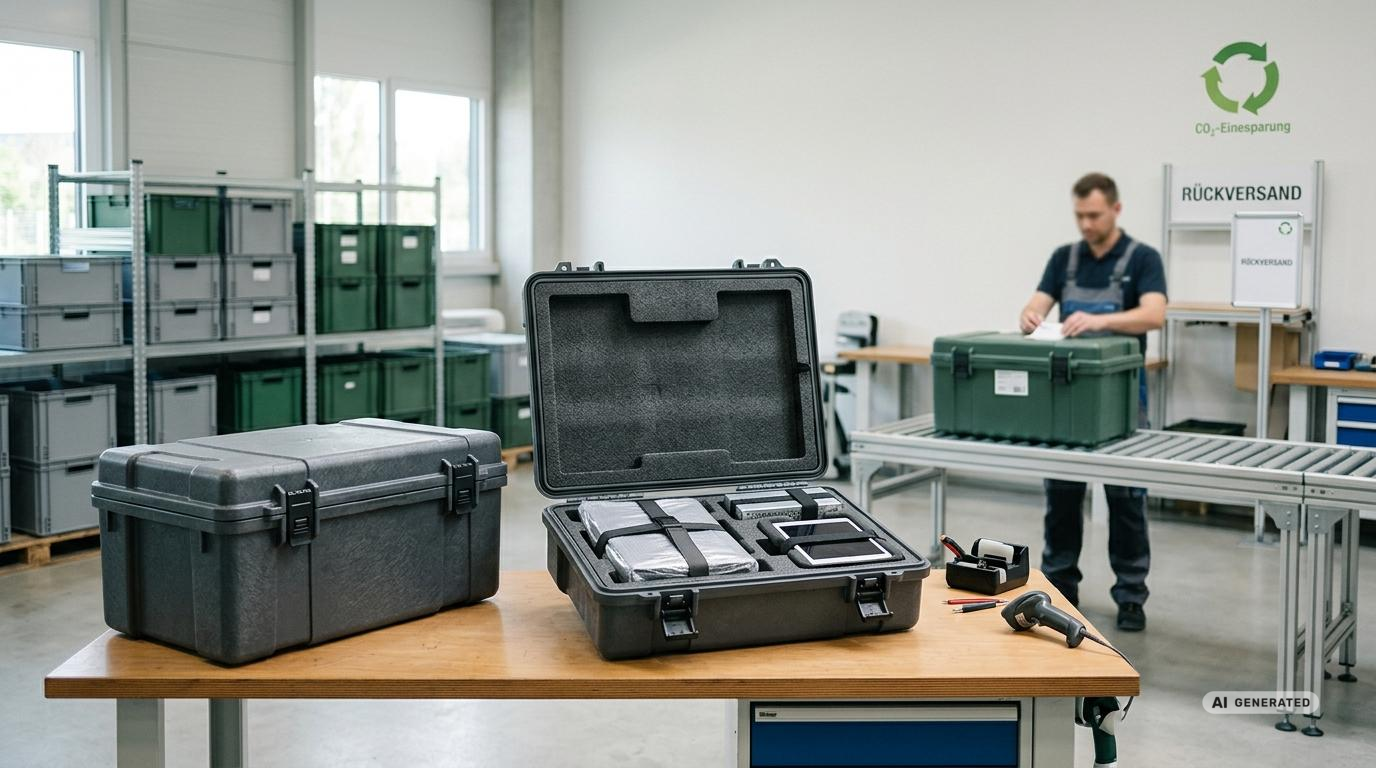
Making Packaging and Logistics Sustainable: Reusable Shipping Containers, Return Shipping Processes, andCO2 Reduction
Sustainable logistics doesn’t start with the transport vehicle. Even the choice of packaging, how efficiently a package is packed, and the organization of returns influence a project’s resource consumption. This is particularly relevant when renting out tablets, smartphones, laptops, computers, VR headsets, and accessories. The devices must arrive safely at their destination and be reliably returned once the project is complete.
A sustainable packaging strategy therefore considers more than just the material of a shipping box. What matters most is the entire system encompassing product protection, reusable packaging, transport planning, return logistics, cleaning, inspection, and re-deployment. Well-organized reusable cycles can reduce packaging waste, simplify processes, and lay the groundwork for a more transparentcarbon footprint. The article on sustainable logistics in IT addresses additional practical aspects.
Why Packaging and Logistics Should Be Planned Together
Packaging can be made from resource-efficient materials and still have a poor environmental footprint. This is the case, for example, if it is oversized, is reused only a few times, or requires additional transportation for return. Conversely, a sturdy reusable box can make sense despite using more material if it is used frequently, transported in a space-saving manner, and can be repaired if damaged.
For companies, this means that sustainability is not determined by a single material property. What matters most are the actual usage cycles and the integration of the packaging into effective logistics processes. A good solution protects the technology, can be handled efficiently, and returns to the cycle with as little effort as possible.
Special Requirements for Mobile Devices
Technology places high demands on transport packaging. Displays, housings, connectors, cameras, and batteries must be protected from impacts, pressure, moisture, and extreme temperature fluctuations. At the same time, devices should be able to be quickly unpacked, distributed, tracked, and returned in full after use.
Complexity increases with larger projects. In addition to end devices, power supplies, charging cables, routers, SIM cards, mounts, headphones, input devices, and anti-theft devices may be required. If there is no clear assignment, this leads to follow-up questions, time spent searching, and possibly additional shipments. Sustainable packaging planning is therefore also a tool for more efficient project management. The guide to planning accessories for event IT shows how to systematically put together a set of accessories.
When shipping devices with rechargeable batteries, the applicable transportation regulations must also be observed. The packaging, labeling, and shipping method must be appropriate for the device, the condition of the battery, and the chosen mode of transport. This point should be incorporated into the planning process early on, especially for international operations.
Reusable transport boxes as part of a closed-loop system
Reusable transport boxes are designed for repeated use. Depending on the application, options include sturdy plastic containers, reinforced cases, stackable transport boxes, or custom-equipped cases. For mobile technology, custom-fit inserts are useful because they limit movement during transport and keep sensitive components separate from one another. For larger tablet projects, for example, a tablet flight case can be a suitable transport and charging solution. The specific configuration is tailored to the project’s needs.
However, a box does not become sustainable simply because it can be reused multiple times. It must actually be returned and reused. This requires clear processes, designated responsible parties, and monitoring of the circulation of the boxes. High return rates, short return routes, and a long service life improve the conditions for environmentally sound operations.
| Design Feature | Environmental Benefits | Operational Benefits | Key Consideration |
|---|---|---|---|
| Durable Reusable Box | Less packaging waste with multiple uses | Reliable protection for recurring projects | Repairability and actual service life |
| Precisely Fitting Inserts | Less additional filler material | Faster packaging and lower risk of damage | Adaptable to different device models |
| Stackable Format | Better utilization of transport capacity | Easier storage and handling | Compatibility with warehouses and transportation equipment |
| Replaceable Components | Extended service life of the entire packaging system | Damaged parts can be replaced individually | Availability of closures, handles, and inserts |
| Digital Labeling | Fewer losses and more documented movements | Better inventory overview and traceability | Data protection and integration with existing systems |
| Foldable design | Reduced volume during empty transport | Takes up less space after return | Adequate protection for sensitive equipment |
Proper sizing reduces material and shipping volume
Oversized packaging requires more material, takes up additional cargo space, and often necessitates larger amounts of cushioning. A compact solution, on the other hand, can reduce the number of packages and improve transport capacity utilization. When renting out equipment, packaging should therefore be tailored to the size of the devices, the number of units, and the accessories.
Modular inserts offer a practical advantage here. Depending on the project, different compartments can be filled with tablets, smartphones, power adapters, or routers. This allows a single box to be used for multiple device combinations. At the same time, the organization remains clear.
However, the smallest possible packaging is not automatically the best. Protecting the devices remains a priority, as damage during transport can result in replacement shipments, additional trips, and increased resource requirements. Sustainable packaging design therefore means avoiding unnecessary empty space without compromising the safety of the equipment.
Return processes determine the success of reusable systems
A reusable system only works if returns are organized in a simple and unambiguous manner. Complicated processes increase the risk of delayed, incomplete, or misaddressed returns. A customer-friendly return process should therefore be planned well in advance of delivery. For more detailed information, see the article on reusable transport boxes and return processes in hardware logistics.
- Plan the return well in advance: The return date, pickup location, and designated contact person should be agreed upon before the project begins, if possible.
- Keep the packaging: Boxes, inserts, and protective components remain available at the site for the duration of the rental.
- Clearly label accessories: Labeled compartments and packing lists indicate which device and which accessory belong in which position.
- Prepare return documents: Shipping information and return labels are prepared so that no additional coordination is required.
- Coordinate pickup: The time window and accessibility of the pickup location are clarified with the project managers.
- Verify returns: Upon receipt, equipment, accessories, and packaging are inventoried, inspected, and prepared for the next assignment.
get-IT-easy provides return labels and arranges for pickup. The customer packs the equipment securely in the provided packaging. Unless otherwise agreed, delivery and pickup are included in the shipping costs. The specific process depends on the scope, delivery location, and requirements of the respective project.
How to ReduceCO2 Emissions in Logistics
The switch to reusable boxes is an important approach, but not the only one. EffectiveCO2 reduction takes into account packaging production, transportation, storage, return, cleaning, and potential losses. Companies should therefore combine several measures.
- Consolidate shipments: Devices and accessories are shipped together whenever possible, rather than sending multiple small shipments.
- Optimize packaging volume: Appropriate box sizes and modular inserts reduce empty space and packing material.
- Plan for return shipments: Returns should be integrated into existing transportation processes, if the project schedule and availability allow.
- Increase turnover rates: Cleaning, maintenance, and repairs extend the service life of reusable packaging.
- Prevent losses: Labels, barcodes, QR codes, or RFID solutions support tracking and inventory control.
- Reduce damage: Appropriate cushioning and clear packing instructions prevent additional shipments caused by damaged equipment.
- Collect data: Circulation cycles, transport routes, weights, packaging losses, and repairs provide a solid foundation for improvements.
Why the number of cycles is more important than the “reusable” label
Manufacturing a durable shipping box requires materials and energy. This initial investment is only spread out over a larger number of shipments with each subsequent use. If a box is damaged early on, not returned, or stored permanently, it cannot realize its full environmental potential.
Companies should therefore not just count how many reusable containers they have. A more meaningful metric is the number of cycles actually completed. Other important metrics include the return rate, the average service life, the repair rate, the weight per shipment, and the proportion of additional deliveries due to missing parts or damage. Such data can also be relevant for sustainability reporting, as explained in the article on CSRD and key metrics for equipment fleets.
The distance of the return transport also plays a role. Reusable concepts are particularly effective when return routes are sensibly planned and empty runs are avoided. For widely dispersed locations, regional collection points, consolidated pickups, or coordinated project logistics can help.
Digital traceability improves the circular process
Digital labeling is becoming increasingly important in packaging logistics. Each box can be assigned a unique identifier linked to equipment lists, shipping data, condition, and the number of previous cycles. Scanning upon shipment, handover, return, and inspection reveals the packaging’s current location.
QR codes are relatively easy to implement. RFID technology can offer advantages for large volumes because multiple tagged items can be recorded more quickly. The appropriate solution depends on the number of units, process volume, IT infrastructure, and desired level of data detail.
The current trend toward digital product information and standardized data structures reinforces this development. For reusable packaging, this does not necessarily mean that every company immediately needs a complex system. Even a unique box number, a digital packing list, and a documented condition check can reduce losses and inquiries.
Cleaning, inspection, and repair are part of the sustainability strategy
The packaging process does not end after return. Boxes and inserts must be cleaned, inspected, and repaired as needed. Latches, handles, casters, hinges, and padding are typical wear-and-tear parts. If these components can be replaced separately, the entire package does not have to be discarded.
The cleaning method also affects the environmental impact. The effort required should be commensurate with the actual degree of soiling. At the same time, hygienic, technical, and project-specific requirements must be met. Reusable inserts should be designed so that they are easily accessible and can be cleaned with reasonable effort.
As for the equipment itself, the return process also involves several steps. The devices are inspected, cleaned, and prepared for their next use. Customer data is removed after return. In cases involving sensitive data or internal data protection policies, certified data erasure can be requested on a case-by-case basis. Additional information is available in the guide on secure provisioning and data erasure for event hardware.
Packaging requirements will become strategically more important in 2026
The European Packaging Regulation will generally take effect on August 12, 2026. At the same time, the national legal framework in Germany will be amended. As a result, waste prevention, reuse, design for recycling, packaging minimization, and traceable circular processes will take center stage.
For companies, this is an opportune time to review existing processes. This goes beyond mere formal requirements. A structured assessment can reveal where too much filler material is being used, where packaging is lost, where returns are unnecessarily complicated, or where data on actual circulation is missing.
The specific obligations that apply depend on a company’s role, the type of packaging, and its business model. For detailed legal questions, an individual expert review is therefore recommended.
Equipment Rental Supports Circular Project Models
Sustainable packaging logistics is particularly well-suited to a rental model. Equipment is provided for a specified period, returned after use, inspected, and reused. This allows companies to obtain the right equipment for temporary needs without having to build up a long-term inventory of unused equipment. The article “Hardware Rental: Environmental Benefits, Utilization, andCarbon Footprint” explains the environmental benefits that can result from this approach.
For trade shows, training sessions, exams, rollouts, software testing, promotional events, roadshows, and temporary worksites, the device type, quantity, accessories, and configuration can be tailored to actual needs. Apps, user accounts, settings, SIM cards, routers, and other accessories can be set up upon request. A project-specific configuration of the rental devices can significantly reduce the effort required on-site.
At get-IT-easy, rentals are available starting from one day. Availability, delivery time, configuration, and logistics are reviewed for each request. The rental price depends on factors such as the device, quantity, rental period, accessories, delivery method, and desired additional services. Interested parties will receive a customized quote via email.
FAQ on Sustainable Packaging and Return Shipping
Are reusable transport containers generally more sustainable than single-use packaging?
That depends on the specific system. A reusable box can offer environmental benefits if it is reused many times, is reliably returned, and does not result in disproportionately long additional transport distances. Material, weight, cleaning, repairs, and loss rates must also be taken into account.
Why are custom-fit inserts useful for mobile devices?
They protect devices and accessories, reduce movement inside the box, and can eliminate the need for additional packing material. They also make it easier to verify that all items are present when the box is issued and returned.
How can a company simplify the return process?
Pre-printed return labels, clear packing lists, designated contact persons, and pickup dates arranged well in advance are helpful. The original packaging should be stored securely throughout the project.
Which metrics are suitable for evaluating a reusable system?
Key metrics include circulation rate, return rate, service life, repair rate, loss rate, packaging weight, transport volume, and the number of additional shipments. For aCO2 assessment, transport routes and shipping methods should also be taken into account.
Can large quantities of equipment also be delivered in reusable boxes?
This depends on the type of equipment, quantity, delivery location, and project requirements. For large quantities or extensive pre-configuration, packaging and delivery planning are coordinated on a case-by-case basis. The selection ranges from mobile devices to other rental equipment.
What happens after the rental equipment is returned?
The equipment is inspected, cleaned, and prepared for future use. Customer data is removed. The shipping packaging is also inspected and, if necessary, cleaned or repaired.
Conclusion
Sustainable packaging is not just about the materials used. It results from the interplay of durable, reusable shipping containers, proper sizing, effective equipment protection, transparent tracking, and easily organized returns. The better these elements are coordinated, the more effectively packaging waste, transport damage, and unnecessary additional shipments can be reduced.
A coordinated rental concept offers practical advantages, especially for time-limited technology projects. Companies receive the tablets, smartphones, laptops, computers, VR headsets, and accessories they need, tailored to the duration of use and scope of the project. Packaging, delivery, configuration, and return can all be planned together.
Anyone who needs technology for an event, a training session, a rollout, or a temporary workspace can compile a list of the desired devices using get-IT-easy’s request form. Details regarding quantity, rental period, location, and accessories simplify the planning process. Based on this information, availability and requirements are reviewed, and a customized quote is prepared.
Read more - You may also be interested in
Would you like to delve deeper into the topic or discover similar content? Below, we have compiled three additional articles for you that are thematically related to this article. These may also be relevant and interesting for your company.

Leasing Solutions for Businesses
TV/Display Rentals for Trade Show Booths & Events: Resolution, Mounts/Stands, Setup & Data Protection
TV and Display Rentals for Trade Show Booths and Events: Tips on resolution, mounts, stands,
Aug
Guide
Transfer Data Quickly Between PCs Without a USB Drive: Simple Methods for Event Teams
Transfer data quickly between PCs without a USB drive: simple, secure methods for event teams—from
Aug

Technology Trends
EUDI Wallet & Digital Identities: Potential Applications for Check-In, Access Control, and Verification at Events
EUDI Wallet at Events: Digital identities for fast check-in, secure access control, and reliable verification.
Aug
Sustainability
Making Packaging & Logistics Sustainable: Reusable Shipping Containers, Return Shipping Processes, and CO2 Reduction
📦 Making Packaging & Logistics Sustainable: Reusable shipping boxes, efficient return processes, and lower CO₂
Aug

Technology Trends
5G & Alternative Event Internet: Wi-Fi/5G Setup, VoWiFi, and Stratospheric Internet—What’s Realistic?
A Look at Internet for Events in 2026: 5G, Wi-Fi Setup, VoWiFi, and Stratospheric Internet.
Jul

Guide
Secure Wi-Fi on the Go & at Events: Which Smartphone/Hotspot Features You Should Disable and Why
Secure Wi-Fi on the Go & at Events: These Smartphone & Hotspot Features You Should
Jul

Guide
Geofence Warrants & Data Privacy: What Companies Need to Know About Location Data, Event Tracking, and Apps
Geofence Warrants & Data Protection 2026: What Companies Need to Know About Location Data, Event
Jul
Guide
Pegasus & Mobile Spyware: How Companies Protect Company Devices While Traveling or at Events
Pegasus & Mobile Spyware: How Companies Can Securely and Efficiently Protect Company Devices While Traveling,