




Leasing Solutions for Businesses
Mobile Power & Charging at Events: Power Banks, USB-C Power Adapters, Wireless Chargers—What Really Works
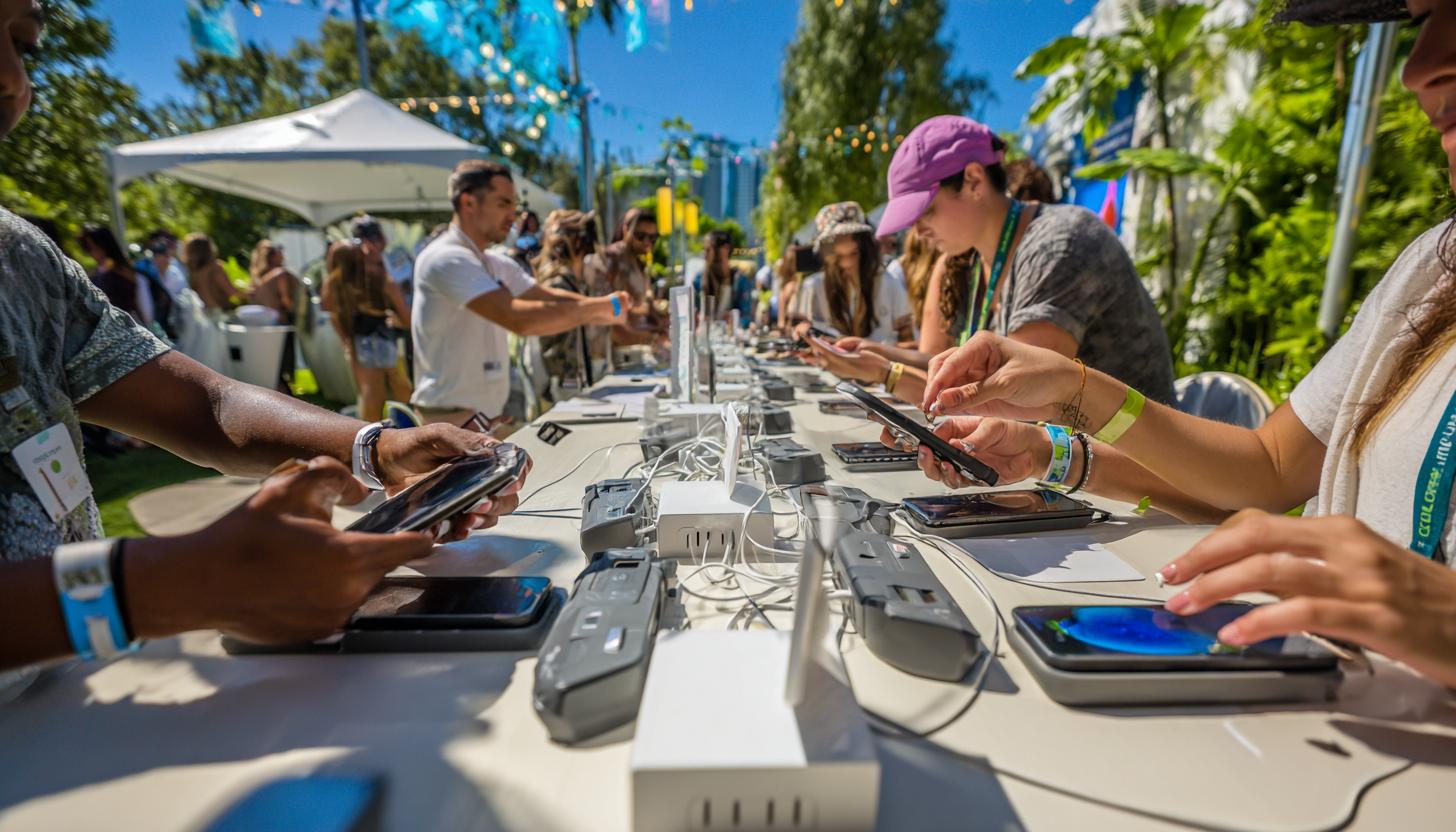
Mobile Power & Charging at Events: Power Banks, USB-C Adapters, Wireless Chargers—What Really Works
Whether it’s a trade show, roadshow, conference, festival, press event, promotional booth, or internal corporate event: Mobile devices are now an integral part of almost every event’s logistics. Smartphones serve as tickets, scanners, cameras, communication hubs, and payment devices. Tablets are used for lead generation, product presentations, and registration. Laptops, mobile routers, scanners, receipt printers, handheld devices, and accessories must operate reliably for hours on end. That is precisely why the issue of mobile power supply at events will be more important than ever for event organizers, agencies, and companies in 2026.
At the same time, the market has changed. USB-C has largely become the standard, fast-charging protocols are more powerful, wireless charging is more widespread, and power banks offer significantly more capacity with better energy management. Nevertheless, real-world experience at events consistently shows that not every charging product performs equally well in professional settings. Some solutions look impressive on paper but fail when faced with large crowds, long operating hours, or mixed device fleets.
In this article, we’ll explore which mobile charging solutions really deliver at events, what the typical pitfalls are, and why rental—rather than buying—is the more cost-effective and reliable choice for many B2B applications.
Why Mobile Power Solutions Are No Longer a Side Issue at Events
In the past, it was often enough to simply provide a few power strips in the back office. Today, that’s not enough. Modern events are digitally driven. Employees, hostesses, sales teams, technicians, and visitors expect devices to be ready for use at all times. When a battery runs out, it’s often not just a single device that comes to a standstill, but an entire process.
A few typical scenarios from the world of event planning:
- Check-in using tablets is slow because many devices don’t last a full day at the trade show.
- A sales team loses leads because smartphones with CRM apps, cameras, and hotspot features run out of battery too quickly.
- During a product presentation, there aren’t enough charging stations for test devices.
- Visitors stay at the booth for shorter periods if there are no convenient charging options available.
- Technical crews have to improvise because power adapters are incompatible or too weak.
Mobile power supply is therefore not just a matter of convenience. It affects visitor retention, workflow, brand perception, reliability, and, ultimately, the financial success of an event.
What Will Really Matter in the Events Industry in 2026
Current market trends clearly show what matters most in charging infrastructure today. Universal standards, high charging power, clean cable designs, device safety, and flexible application scenarios are particularly important. In a professional setting, it’s not just maximum power that counts, but the ability to reliably and transparently supply power to a wide variety of devices.
In the events sector, the following aspects are particularly relevant:
USB-C as the leading standard: New smartphones, tablets, many accessories, and a growing number of laptops are adopting USB-C. This significantly simplifies logistics when chargers and cables are properly planned.
Fast charging with true system compatibility: High wattage ratings on the box aren’t enough. What matters is which protocols are supported and how charging power is distributed when multiple devices are connected at the same time.
Power banks with reliable capacity specifications: When used at events, it’s not just the theoretical rated capacity that counts, but the actual usability, output power, and long-term stability.
Wireless charging as a supplement, not as the sole solution: Wireless charging is appealing for hospitality areas, lounges, and brand experiences. However, it is usually not the primary solution for critical work devices.
Centralized Planning Instead of Ad Hoc Charging: Professional events require a charging and power-sharing strategy, not just individual chargers.
Power Banks at Events: Flexible, Visible, but Not Necessarily the Best Solution
Power banks are the classic choice for mobile power. They’re especially popular at events because they can charge devices without relying on fixed charging stations. This makes them ideal for mobile teams, hostesses, technical support staff, outdoor operations, and visitor services.
The benefit is obvious: A smartphone or tablet can continue to be used while in operation without having to remain at a fixed station. This is a real advantage, especially at trade shows, promotional events, and large event venues. Those planning a structured setup can also take advantage of charging station rentals to centrally charge power banks and devices and distribute them in an organized manner.
However, power banks used in professional settings differ significantly. Key criteria include capacity, output power, number of ports, the power bank’s own charging speed, weight, safety electronics, and labeling for operational use.
For events, models that offer high-performance USB-C ports and can power multiple types of devices are particularly reliable. A compact power bank for a team of smartphone users has different requirements than a model designed to support tablets or even lightweight laptops.
| Use Case | Recommended Solution | What to Keep in Mind |
|---|---|---|
| Hostesses and Promotional Teams | Compact power banks with USB-C and high portability | Lightweight, fast charging, clear labeling |
| Tablet Check-In and Lead Capture | Power banks with higher capacity and stable output power | Continuous operation, cable management, replacement plan |
| Back Office and Technical Crew | Higher-capacity power banks or USB-C power adapters | Multiple ports, high reliability, durable cables |
| Visitor Services at the Booth | Power bank rentals or charging stations available with a deposit or registration | Tracking, return process, branding options |
| Outdoor event without a robust power infrastructure | A combination of power banks and stationary charging stations | Backup devices, weather plan, planning charging cycles |
The operational side is also important. Anyone who wants to use dozens or hundreds of power banks at events needs a structured process for distribution, inventory tracking, and return. This is precisely where a major advantage arises when companies use rental solutions instead of purchasing consumer products at short notice.
USB-C Power Adapters: The Most Reliable Foundation for Professional Charging Operations
When it comes to predictable charging points, fast recharging, and universal compatibility, high-quality USB-C power adapters are often the most efficient solution. They really shine wherever dedicated charging zones or workspaces can be set up. This applies to counters, registration areas, back-office spaces, control rooms, breakout rooms, press areas, and VIP lounges.
The major advantage of modern USB-C power adapters lies in their versatility. A high-performance multiport power adapter can charge multiple smartphones, tablets, or accessories at the same time. With sufficient power, it can often even support laptops or mobile workstations. This reduces the number of individual adapters needed and minimizes cable clutter.
However, there are differences here as well. In day-to-day event operations, the main problems stem from low-cost solutions with unstable performance, unclear port prioritization, or insufficient heat dissipation. Professional chargers should be suitable for continuous operation, support well-known fast-charging protocols, and provide clearly documented performance data. Anyone who also needs to connect mobile teams or temporary workspaces should consider router rentals designed for events so that power supply and connectivity can be planned as an integrated system.
USB-C is particularly beneficial for B2B events because it allows for the creation of a standardized charging infrastructure. This saves time during setup, simplifies on-site support, and reduces user errors. Those who use tablets, smartphones, scanners, and accessories as a set benefit enormously from standardized power adapters and compatible, high-quality cables.
Wireless Chargers: Elegant and Eye-Catching, but With Limitations
Wireless charging stations undoubtedly attract a lot of attention at events. They look modern, fit well into lounge concepts, and can enhance brand presentations. Visitors place their smartphones on a charging station, stay at the booth longer, and associate the service with convenience and innovation.
But in the rigors of everyday event life, wireless charging is usually just a supplement, not the primary power source. It’s less efficient than wired charging, the device has to be positioned correctly, and with heavy smartphone use while charging, the practical benefit is often less than expected. Thick cases, camera bumps, or misalignment can also affect charging performance.
Wireless chargers are particularly useful in the following areas:
- VIP and Hospitality Areas
- Visitor lounges designed for relaxation
- Branding Areas for Modern Product Display
- Conference tables and meeting areas
- Press and Networking Lounges
For operational devices such as check-in tablets, sales smartphones, or scanners, however, wired solutions should be the primary choice. Wireless charging is more appealing in terms of convenience and design than in terms of maximum efficiency. While wireless charging is certainly convenient—especially for devices like the Google Pixel 7 or the latest iPhones—it rarely replaces a fast USB-C or Lightning charging setup in everyday work.
What Really Works in Practice: The Interplay of Systems
The most important lesson from day-to-day event operations is simple: There is no single perfect charging solution that works for everything. Successful approaches combine multiple components in a sensible way. If you only hand out power banks, you’ll quickly lose track of things. Those who set up only fixed charging stations are too inflexible. Those who rely solely on wireless charging often don’t get the performance they want.
A professional mobile power setup therefore usually consists of a mix of stationary and mobile charging options. A typical setup, for example, includes central USB-C charging stations in the back office, supplemental power banks for mobile teams, and select wireless charging stations in visitor areas.
Planning by user group is crucial:
Surgical teams need reliability, backup equipment, clear responsibilities, and fast charging cycles.
Visitors expect convenience, ease of use, and clearly visible charging options.
Technical staff and project managers need a clear overview, compatibility, and seamless processes for distribution and return.
Common Mistakes with Power Supply at Events
Many problems arise not from a lack of equipment, but from poor planning. Anyone setting up a mobile power supply for an event should avoid these mistakes:
- Power adapters that are too weak for tablets or multiple devices at the same time
- Inappropriate or low-quality cables that prevent fast charging
- Not enough spare devices or no system for swapping out empty power banks
- Lack of labeling and inventory tracking for larger quantities
- Underestimated power requirements due to high display brightness, mobile data, and continuous use
- Wireless chargers in locations where fast wired charging is actually needed
- A mix of devices without standardized connectors and adapter planning
These details make a huge difference, especially at trade shows and roadshows, where many devices need to be used simultaneously in a short period of time. This is particularly true when, in addition to smartphones and tablets, mobile hotspots such as the FRITZ!Box 6820 are in use, which also need a reliable power supply. That’s why it’s worth seeking advice in advance. Anyone looking to rent a mobile power solution for an event should not only ask about availability but also about the right setup for the number of people, device types, duration of use, and location.
Why Rental Often Makes More Sense Than Buying in the B2B Sector
For individual office applications, purchasing basic charging products may make sense. In the event and project business, however, the situation is often different. Requirements vary from assignment to assignment. Sometimes 20 power banks are needed, other times 150. Sometimes the focus is on tablets, other times on smartphones, and still other times on charging devices for visitors at the booth. Added to this are transportation, preparation, updating standards, and replacements in case of failures.
Rental offers several clear advantages in a professional setting. Companies receive the quantities they need, modern technology, tested components, and often advice on combining the right equipment. In addition, they save on warehousing, maintenance, and the risk of being stuck with unsuitable inventory.
These points are particularly relevant for agencies, trade show builders, event organizers, and corporate marketing departments:
Scalability: The quantity is adjusted to the specific event.
Up-to-date: Modern USB-C solutions, new charging hardware, and the latest device standards are available immediately.
Consistency: A professional rental company can provide standardized kits that are easier to manage during operations.
Time Savings: No need for time-consuming procurement right before the event.
Support: Questions regarding compatibility, charging performance, and compatible accessories can be clarified in advance.
Anyone who wants to ensure a professional event should therefore view charging infrastructure as part of the event technology and not treat it as a makeshift solution.
Which rental solution makes sense for which event
The ideal configuration depends heavily on the format. A trade show booth with high visitor traffic requires a different approach than an internal conference or an off-site event. In many cases, a modular design is recommended.
A typical example of a successful combination might look like this: In the back office, multi-port USB-C power adapters are available for switching devices and charging on the go. Front-of-house staff are provided with labeled power banks for mobile use. Wireless chargers are also integrated into the lounge to enhance service and the guest experience. Tablets used for registration or data collection are either equipped with dedicated power adapters at the counter or operate on a defined rotation schedule with replacement devices and power banks. For larger fleets of devices, solutions such as the NoteCart Flex 24 can also be effectively integrated to securely store, transport, and charge multiple devices simultaneously.
Depending on the intended use, it’s also worth including the devices themselves in your charging plan. For example, if you’re planning an Apple iPhone rental, you should take charging cycles, cable types, and user profiles into account right from the start. For registration areas or digital product presentations, iPad Air 5 rental is often a good choice, while in a mobile back office or for facilitating and managing events on the go, a 2022 MacBook Air 13″ can also be integrated into a standardized USB-C charging setup.
Even during promotional events, roadshows, and off-site appointments, the vehicle’s power supply plays a bigger role than many teams initially realize. A professional car charger helps ensure that smartphones, tablets, or routers are reliably charged during the trip and between stops.
This is exactly where the advantage of a specialized rental service for technology and mobile devices becomes apparent. Instead of booking individual products separately, you can put together a complete charging setup tailored to the event.
Sustainability, Safety, and Brand Impact
These three points will also become increasingly important in 2026. In the context of events, sustainability means not only energy-efficient technology but also avoiding unnecessary purchases. In many cases, rental reduces excess inventory and extends the professional lifespan of hardware.
Safety is just as crucial. Chargers and power banks must be reliable, certified, and suitable for professional use. This is particularly important at events with large crowds, because charging stations are often in constant use and, in some cases, subjected to heavy wear and tear.
And finally, the brand impact: A highly visible, modern charging solution is more than just infrastructure. It’s a service. It conveys organization, user-centricity, and technological expertise. Especially at trade shows or brand spaces, this can be a key component of the overall experience.
FAQ
Which charging solution is most important for events?
The most important thing is a combination of fixed USB-C charging stations and portable power banks. Wireless chargers are a useful addition in visitor or lounge areas.
Are power banks suitable for tablets?
Yes, as long as the capacity and output power are sufficient. However, for professional, continuous use of tablets, you should consider whether USB-C power adapters or a power rotation strategy would be more efficient.
Is wireless charging worth it at trade shows?
Yes, especially in terms of visitor convenience, the quality of the visitor experience, and brand impact. However, it is usually not the primary solution for core operational processes.
Why should you consider rental of a mobile power supply for an event?
Because the number of units, requirements, and mix of equipment can vary greatly depending on the event. Rental offers flexibility, the latest technology, less storage hassle, and usually a more professional overall solution.
What should you look for in USB-C power adapters?
The key factors are actual output power, support for relevant charging protocols, cable quality, multi-port performance, and suitability for extended use.
How many charging units are needed for an event?
That depends on the number of devices, duration of use, power consumption, and charging options. It’s recommended to determine your exact needs in advance, especially for tablets, check-in solutions, and mobile teams.
Conclusion
Mobile power supply has long been a strategic issue at events. Power banks, USB-C power adapters, and wireless chargers all have their place when chosen to suit the intended purpose. However, it is usually not the individual component that is truly successful, but rather their well-thought-out interaction.
Anyone looking to rent a mobile power solution for an event should opt for professional, scalable, and compatible solutions that fit the event’s schedule. For B2B customers, this means greater operational reliability, less improvisation, and a better experience for teams and visitors. That is precisely the difference between just any charging option and an event solution that truly works in practice.
If you’re looking for the right charging infrastructure for a trade show, roadshow, conference, promotional event, or corporate event, it’s worth submitting a request early. This not only ensures that the right hardware is provided, but also allows us to develop a comprehensive plan that keeps mobile devices running reliably and provides professional support for your event.
Read more - You may also be interested in
Would you like to delve deeper into the topic or discover similar content? Below, we have compiled three additional articles for you that are thematically related to this article. These may also be relevant and interesting for your company.
Leasing Solutions for Businesses
Bring-Your-Own-Device vs. Rented Devices: When Each Strategy Is Worth It for Doctoral Programs
BYOD or Rented Devices? 📱 Find out which strategy is best for promotions in 2026—considering
Aug
Leasing Solutions for Businesses
TV/Display Rentals for Trade Show Booths & Events: Resolution, Mounts/Stands, Setup & Data Protection
TV and Display Rentals for Trade Show Booths and Events: Tips on resolution, mounts, stands,
Aug
Guide
Transfer Data Quickly Between PCs Without a USB Drive: Simple Methods for Event Teams
Transfer data quickly between PCs without a USB drive: simple, secure methods for event teams—from
Aug
Technology Trends
EUDI Wallet & Digital Identities: Potential Applications for Check-In, Access Control, and Verification at Events
EUDI Wallet at Events: Digital identities for fast check-in, secure access control, and reliable verification.
Aug
Sustainability
Making Packaging & Logistics Sustainable: Reusable Shipping Containers, Return Shipping Processes, and CO2 Reduction
📦 Making Packaging & Logistics Sustainable: Reusable shipping boxes, efficient return processes, and lower CO₂
Aug

Technology Trends
5G & Alternative Event Internet: Wi-Fi/5G Setup, VoWiFi, and Stratospheric Internet—What’s Realistic?
A Look at Internet for Events in 2026: 5G, Wi-Fi Setup, VoWiFi, and Stratospheric Internet.
Jul
Guide
Secure Wi-Fi on the Go & at Events: Which Smartphone/Hotspot Features You Should Disable and Why
Secure Wi-Fi on the Go & at Events: These Smartphone & Hotspot Features You Should
Jul

Guide
Geofence Warrants & Data Privacy: What Companies Need to Know About Location Data, Event Tracking, and Apps
Geofence Warrants & Data Protection 2026: What Companies Need to Know About Location Data, Event
Jul