





Guide
Protection Against Supply Chain Attacks in Event IT: Securely Procuring, Configuring, and Operating Hardware and Software

Protection Against Supply Chain Attacks in Event IT: Securely Procuring, Configuring, and Operating Hardware and Software
The digitization of events has fundamentally transformed the events industry in recent years. Check-in systems, mobile devices, digital signage, point-of-sale systems, badge printers, networking technology, streaming setups, and temporary back-office infrastructures are now standard features at trade shows, conferences, roadshows, annual shareholder meetings, and corporate events. At the same time, this brings with it a growing risk that by 2026 will no longer affect only large corporations, but also event organizers, agencies, technical service providers, and IT managers in the event sector: supply chain attacks.
Anyone who plans, uses rental services for, or operates event IT no longer has to limit themselves to answering the traditional questions about availability, performance, and user-friendliness. It has also become crucial to know where devices, software, images, accessories, updates, and configurations come from; who has access to the supply and operations chain; and how tampering can be detected early on. This is precisely where the topic of supply chain security in Event IT 2026 comes into play.
This issue is particularly relevant for companies that rely on rental equipment and temporary IT infrastructure. On the one hand, professional rental services offer clear advantages such as standardized processes, tested hardware, rapid scalability, and short-notice availability. For example, anyone looking for Apple iPad rental services for events rightly expects not only modern hardware but also transparent security and deployment processes. On the other hand, customers today generally expect the security chain—from receipt of goods to return—to be thoroughly documented and monitored. In this article, we’ll show what will matter in 2026, which risks are realistic, and how event IT can be securely procured, configured, and operated.
Why Supply Chain Security Has Become So Important in Event IT
Supply chain attacks do not primarily target the company itself, but rather its suppliers, service providers, software sources, hardware channels, or management processes. In the case of event IT, the attack surface is naturally high because many factors come into play: short setup times, changing locations, temporary networks, various service providers, numerous end devices, and high time pressure.
A compromised tablet at the guest reception desk, a tampered app for lead capture, insecure firmware in network equipment, or a laptop that was delivered with pre-installed modifications can have serious consequences. These include data leaks, check-in failures, tampered presentations, compromised payment processes, or damage to the event’s reputation among exhibitors, sponsors, and visitors.
Current market discussions in 2026 are centered primarily on three developments: First, attacks on software supply chains continue to increase, for example, through package repositories, plug-ins, remote maintenance tools, or update processes. Second, there is growing attention to hardware integrity, serial number tracking, secure boot, firmware protection, and trusted procurement channels. Third, more and more companies in the B2B sector are requiring robust security evidence even from event and rental technology partners, as compliance requirements, information security, and data protection are increasingly viewed as interconnected.
Common Weaknesses in the Event Technology Supply Chain
In the context of events, risks arise not only at the manufacturer level but throughout the entire supply chain: procurement, warehousing, imaging, shipping, setup, on-site operation, remote support, user changes, and return. The situation becomes particularly critical when equipment is procured on short notice from various sources or prepared using non-standardized processes.
- Unsecure procurement channels: Devices from non-transparent sources, opened packaging, missing proof of origin, or unauthorized resellers increase the risk of tampering.
- Uncontrolled software configurations: Undocumented system images, outdated operating systems, manually installed apps, and poorly maintained drivers create unnecessary entry points.
- Lack of device hardening: Default passwords, open interfaces, enabled debug modes, or unprotected BIOS/UEFI settings remain common problems.
- Too many stakeholders: Agencies, event organizers, IT service providers, venues, streaming providers, and external support staff often access systems simultaneously.
- Time pressure during rollout: When devices are set up “quickly” the day before, verification, documentation, and testing often fall by the wayside.
- Temporary networks: Event LANs and Wi-Fi networks are often set up on short notice and are not always adequately segmented or monitored.
In the event industry in particular, it is not only the reliability of an individual device that matters, but also the quality of the entire deployment process. A professional rental partner can make a significant difference here if they have structured lifecycle processes, standardized configurations, and traceable device checks.
Secure Procurement: The First Line of Defense for Event IT
The security chain begins long before a device is turned on for the first time. Anyone purchasing or renting hardware for events should ensure traceable supply chains, documented serial numbers, and established quality processes. In 2026, this will be truer than ever: cost savings from gray-market procurement channels are rarely worth the security risk.
When it comes to laptops, tablets, smartphones, scanners, kiosk systems, access points, or printers, it makes sense to rely on established manufacturers, authorized distributors, and clearly defined incoming goods inspections. This applies, for example, to Apple iPhones used as rental devices, which are frequently employed at events for crew communication, mobile approvals, or content production. This is not just a matter of authenticity, but also of consistency: device batches, BIOS/firmware versions, replacement parts, power adapters, and accessories should be standardized as much as possible. The more heterogeneous the fleet, the more difficult it becomes to manage it securely before an event.
For B2B customers who use rental services for event IT instead of buying it, it’s worth taking a closer look at the rental process. Are devices inspected and re-provisioned after they’re returned? Are there documented procedures for data erasure and reinstallation? Are security-related settings reset with every delivery? Is there a traceable asset-tracking system in place? These questions should be a given today.
| Category | Risk | Security Measure 2026 | Benefits for Events |
|---|---|---|---|
| Hardware Procurement | Tampered or Non-Standard Devices | Authorized sources of supply, serial number tracking, incoming goods inspection | Reliable rollout, reduced risk of tampering |
| Operating System & Images | Outdated or insecure default installations | Signed master images, secure image pipeline, documented approvals | Rapid deployment with a consistent level of security |
| Apps & Tools | Compromised packages or insecure plug-ins | Approved software lists, hash/signature verification, minimal app selection | Fewer disruptions and a smaller attack surface |
| On-site Network | Lateral Movement of Attackers in the Event Network | Segmentation, NAC, WPA3-Enterprise, separate VLANs | Stable operation of check-in, streaming, and back-office systems |
| Device Operation | Misuse by Users or Third Parties | Kiosk Mode, MDM/UEM, Least Privilege, Remote Lock/Wipe | Secure Use Even in Public Areas |
| Return & Reuse | Residual Data on Leased Devices | Certified Data Erasure, Reprovisioning, Audit Logs | Data Protection and Secure Reuse |
Securing the Software Supply Chain: From the App to the Update
Most public discussions about supply chain attacks now focus on software. This is also relevant for event IT, as events often use a mix of off-the-shelf software, event apps, sponsor tools, browser applications, meeting platforms, scanning apps, print components, and configuration profiles. Every additional module can become a risk.
That is why only truly necessary applications should be installed on event devices. A role-based device concept is particularly effective for rental devices: reception tablets are equipped only with check-in software, lead capture devices only with the approved trade show app, and presentation laptops only with specific presentation and collaboration tools. For stationary workstations in the organization or accreditation areas, specifically secured Office laptops for rental are often the best option because they can be consistently configured and centrally managed. In practice, less software almost always means greater security and more stable operation.
How updates are handled is also important. An unplanned live update right in the middle of setup or on the day of the event can be just as problematic as a missing security update. That’s why professional providers rely on testing windows, approval processes, and reproducible installation states. Ideally, each device model is rolled out with a validated image whose components have been tested and documented.
In professional settings, cryptographic integrity checks, signed packages, SBOMs (Software Bills of Materials), and traceable build and deployment processes are also becoming increasingly important. Not every event setup requires a full-fledged enterprise framework, but the trend is clear: Even temporary IT infrastructure must now be set up in a traceable and audit-ready manner.
Secure Basic Configuration for Mobile Devices at Events
Mobile devices play a central role at many events. Tablets for registration and self-service, smartphones for crew communication, laptops for production and speaker support, and rugged scanners for admission management are indispensable. That is precisely why they deserve a particularly rigorous security configuration.
By 2026, the following measures will be standard practice for secure event delivery:
- Comprehensive device management via MDM/UEM: This allows for centralized control of profiles, apps, password policies, restrictions, and remote actions.
- Kiosk or Single-App Mode: Public devices should display only the required application and not allow unrestricted system use.
- Secure Boot, disk encryption, and strong authentication: These measures effectively prevent tampering and local access.
- Disabling Unnecessary Interfaces: Bluetooth, USB data access, developer options, and ad hoc functions should only be enabled when they are truly needed.
- Network profiles with clear guidelines: No open Wi-Fi networks, no spontaneous hotspots, no arbitrary third-party connections.
- Remote Lock, Remote Wipe, and geofencing: These features are especially valuable when dealing with distributed event venues and a large number of rental devices.
Compact devices such as the iPad 11 are often a good choice for self-service terminals, digital visitor guidance, or mobile registration stations because these models work well in kiosk mode and can be quickly integrated into standardized fleets. For rental customers, it’s important that these measures be implemented ideally before delivery. This saves time during setup and reduces the risk of human error on-site. At the same time, it improves the user experience, as devices arrive ready to use.
Network Security at Events: The Often-Underestimated Factor
Even perfectly configured devices are only as secure as the network in which they operate. However, event venues often present complex realities: venue networks, temporary access points, production networks, exhibitor Wi-Fi networks, guest access, streaming connections, and mobile backup connections all run in parallel. Without segmentation and clear lines of responsibility, a dangerous mix of operations can quickly arise.
Modern event IT should therefore be strictly separated into security zones. Check-in systems, payment terminals, production systems, speaker equipment, guest Wi-Fi, and back-office systems must not operate uncontrolled on the same network. VLAN configurations, firewall rules, secure management access, and a minimum number of open ports are mandatory today. In addition, NAC solutions help ensure that only known and authorized devices are allowed onto the production network. Anyone who needs additional connectivity for temporary locations should also look for professional router equipment available for rental that comes with defined security profiles.
Mobile fallbacks will also continue to gain importance in 2026—not only for availability but also as a targeted security strategy: An isolated 5G fallback for particularly critical services can be a sensible option when venue networks are problematic. This can be a robust addition, particularly for highly sensitive events such as executive board meetings, press events, or exclusive B2B conferences. In smaller setups, a properly configured FRITZ!Box 6820 often suffices as an LTE router, provided that segmentation and access protection are planned from the outset.
Operations, Monitoring, and Incident Response During the Event
Supply chain security does not end with delivery. How the system operates in production determines whether anomalies are detected early or only noticed when a failure occurs. This includes monitoring, logging, assigned responsibilities, and rapid response options.
In practice, it makes sense to establish clear security responsibilities for each event: Who is authorized to replace devices? Who approves software changes? Who decides whether to disconnect from the network, isolate devices, or perform a reinstallation in the event of an incident? Especially when multiple service providers are involved, a defined escalation plan helps prevent many problems.
Standardized checklists for setup day, event operations, and teardown are also helpful. For example, these can be used to verify whether only authorized devices are active on the network, whether there are any unusual login attempts, or whether unexpected software has been installed. For rented devices, it is also important that replacement devices are configured with the same security baseline as the primary systems.
Professional rental companies and technology partners can provide real added value here by not only supplying hardware but also offering preconfigured fleets, documented replacement processes, and optional support for secure operation. For customers, this means less improvisation and more reliability.
Data Protection, Compliance, and Accountability
Event IT frequently processes personal data: participant lists, ticket information, email addresses, movement and access information, transaction data, and communication content. For this reason, supply chain security in Event IT 2026 directly overlaps with data protection and compliance.
Today, companies are paying closer attention to ensuring that even temporarily deployed technology is properly documented. This includes order processing, secure data deletion upon project completion, access logs, role- and permission-based frameworks, and clear accountability. Technology or equipment rental partners who work with standardized security and data deletion processes provide their customers with not only technical security but also organizational security.
This is increasingly becoming a key factor in the decision-making process, especially in the B2B sector. It’s not just the price of the equipment that matters, but also whether a provider can deliver secure and reproducible processes. For high-stakes events involving sensitive participant data, this is a clear competitive advantage.
Why Rental Can Often Be Safer Than Buying on a Whim
Many companies are finding that, while procuring event hardware on short notice may seem flexible at first glance, it actually creates security issues in practice. Typical consequences include different generations of devices, incompatible chargers, a lack of MDM, software versions that are difficult to verify, and improvised user accounts. Added to this is the effort required for resetting, updates, storage, and data protection after the event.
A specialized B2B rental service focused on technology and mobile devices can offer clear advantages here: standardized device pools, professional re-provisioning, tested accessory sets, traceable lifecycle processes, and—upon request—preconfigured software environments. For executive events or demanding presentation scenarios, devices such as the 11-inch iPad Air M3 are available for rental when security, performance, and a high-quality display are all required. This not only reduces IT risks but also often saves time in project management and logistics.
Anyone who regularly plans events, roadshows, trade shows, or rollouts should therefore not only inquire about available equipment, but also specifically ask about security and deployment standards. Today, a good rental partner is more than just a hardware supplier—it is part of a trustworthy supply chain.
Best Practices for Secure Event IT in 2026
Anyone who wants to set up event IT securely should take a holistic approach to the issue. It is not a single measure that protects against supply-chain attacks, but rather the combination of procurement, standardization, device management, network security, and proper operations.
Standardized device concepts, a small number of approved software modules, centralized management, documented handoffs, and the use of preconfigured rental devices from specialized providers have proven particularly effective. For mobile teams, moderation, approval workflows, or social media production, rental of modern devices such as the iPhone 16 Pro can also be a sensible option, provided they are operated in accordance with clear guidelines and robust mobile device management. This reduces the error rate and makes security more predictable.
If you need tablets, smartphones, laptops, scanners, digital signage hardware, or complete mobile IT workstations for your events, it’s worth planning early with an experienced B2B partner. For traditional back-office, organizational, and project workstations, rugged business devices such as the Lenovo T14 —available as a rental laptop —are often used because these models are easy to standardize and manage securely. This not only allows for better coordination of quantities and logistics but also enables security profiles, app configurations, network settings, and rollout processes to be defined in advance. This leads to more stable events and significantly reduces operational risks.
FAQ: Supply Chain Security in Event IT
What is a supply chain attack in event IT?
This refers to an attack in which the event or the organizer is not directly targeted, but rather a part of the supply or provisioning chain. This can involve tampered hardware, compromised software, insecure updates, faulty images, or misused service provider access credentials.
Why aren’t rented devices automatically unsafe?
Rented devices are not inherently riskier. On the contrary: If a professional provider follows standardized testing, deletion, and configuration processes, rented devices are often more secure than solutions you set up on your own on the fly. The key factor is the quality of the rental partner’s processes.
Which devices are particularly critical at events?
Check-in tablets, scanners, payment terminals, production laptops, presenter laptops, network components, and devices with access to participant data or internal company systems are particularly sensitive. For hybrid use cases where the convenience of a tablet is to be combined with the functionality of a laptop, devices such as the Surface Pro 8—during rental —are also considered security-sensitive systems because they are often used for moderation, control room operations, or mobile workstations.
What role does MDM play in mobile event devices?
MDM, or UEM, enables centralized device management. It allows you to deploy apps, enforce security policies, lock devices, erase data, and set usage restrictions. For professional event fleets, this will be virtually indispensable by 2026.
How can data on rented devices be protected after the event?
It is important to have clearly defined decommissioning and deletion processes. These include secure data deletion, re-provisioning, audit logs, and the consistent separation of customer-specific data from the standardized system image.
What should you keep in mind when requesting Event-IT?
In addition to availability and price, customers should inquire about security standards, configuration options, app deployment, device management, data deletion, replacement procedures, and documentation. The more professional the provider is in these areas, the more secure and seamless the event will be.
Conclusion
Supply Chain Security Event IT 2026 is no longer a niche topic, but rather a central component of modern event planning. Anyone who wants to securely procure, configure, and operate hardware and software for events needs transparent supply chains, standardized processes, hardened devices, controlled software versions, and a well-defined on-site operational concept.
In the B2B environment in particular, these factors are increasingly decisive for a project’s success. After all, a technically impressive event is of little use if access control systems fail, data is compromised, or makeshift equipment disrupts the security chain. Conversely, professionally prepared rental solutions offer real advantages: rapid availability, scalable quantities, consistent configurations, and a higher level of security throughout the entire equipment lifecycle.
If you’re planning event IT for trade shows, conferences, roadshows, registration processes, mobile workstations, or digital activation areas, it’s worth reaching out to an experienced rental partner early on. This ensures that not only does the technology work, but the supply chain behind it is also reliable, transparent, and resilient.
Read more - You may also be interested in
Would you like to delve deeper into the topic or discover similar content? Below, we have compiled three additional articles for you that are thematically related to this article. These may also be relevant and interesting for your company.
Leasing Solutions for Businesses
Rental vs. Buying Trade Show and Event Hardware: Costs, Flexibility, and Typical Setups for Businesses
Rental of trade show and event equipment instead of buying it: Cut costs, stay flexible,
Sep
Leasing Solutions for Businesses
Bring-Your-Own-Device vs. Rented Devices: When Each Strategy Is Worth It for Doctoral Programs
BYOD or Rented Devices? 📱 Find out which strategy is best for promotions in 2026—considering
Aug
Leasing Solutions for Businesses
TV/Display Rentals for Trade Show Booths & Events: Resolution, Mounts/Stands, Setup & Data Protection
TV and Display Rentals for Trade Show Booths and Events: Tips on resolution, mounts, stands,
Aug
Guide
Transfer Data Quickly Between PCs Without a USB Drive: Simple Methods for Event Teams
Transfer data quickly between PCs without a USB drive: simple, secure methods for event teams—from
Aug

Technology Trends
EUDI Wallet & Digital Identities: Potential Applications for Check-In, Access Control, and Verification at Events
EUDI Wallet at Events: Digital identities for fast check-in, secure access control, and reliable verification.
Aug
Sustainability
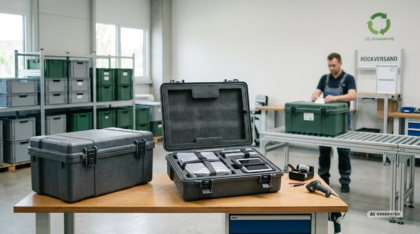
Making Packaging & Logistics Sustainable: Reusable Shipping Containers, Return Shipping Processes, and CO2 Reduction
📦 Making Packaging & Logistics Sustainable: Reusable shipping boxes, efficient return processes, and lower CO₂
Aug

Technology Trends
5G & Alternative Event Internet: Wi-Fi/5G Setup, VoWiFi, and Stratospheric Internet—What’s Realistic?
A Look at Internet for Events in 2026: 5G, Wi-Fi Setup, VoWiFi, and Stratospheric Internet.
Jul

Guide
Secure Wi-Fi on the Go & at Events: Which Smartphone/Hotspot Features You Should Disable and Why
Secure Wi-Fi on the Go & at Events: These Smartphone & Hotspot Features You Should
Jul