





Leasing Solutions for Businesses
Setting Up a Temporary 10-Gigabit Network: 10-Gbit/s Adapters, Switches, and Cabling for Event and Press Areas
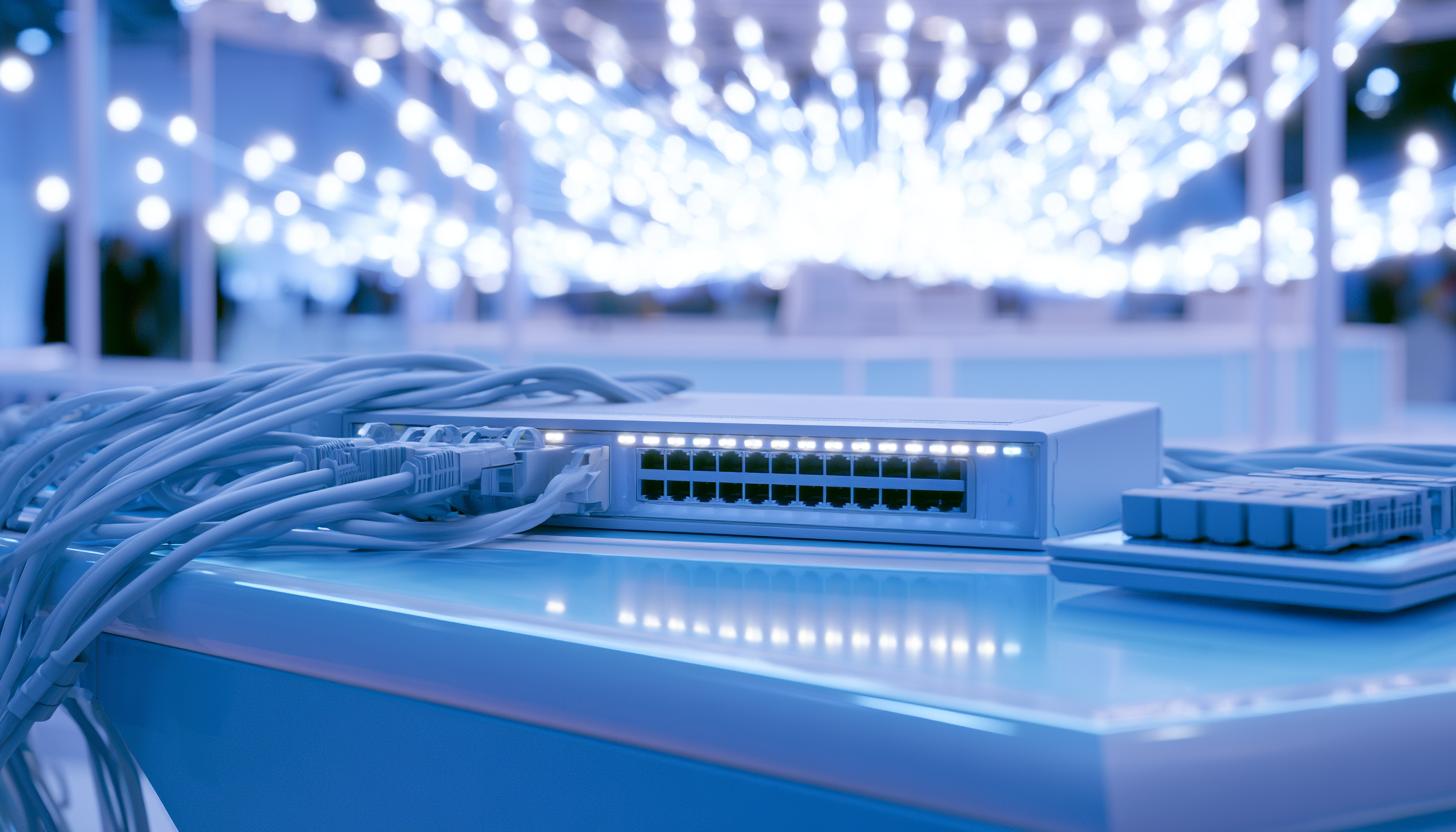
Setting Up a Temporary 10-Gigabit Network: 10 Gbit/s Adapters, Switches, and Cabling for Event and Press Areas
Anyone who needs to reliably transmit large amounts of data in a short period of time at an event, a press conference, a trade show, a roadshow, or a temporary production site will quickly reach the limits of a traditional 1-Gbit network. Especially in press areas, media centers, control rooms, streaming zones, and back-office spaces, demands have been rising significantly for years. Large photo and video files, live uploads to newsrooms, parallel streams, NAS access, cloud syncs, backup processes, and the operation of multiple mobile workstations now require an infrastructure that not only functions but also handles peak loads with ease. This is precisely where the option of network rental for a 10 Gbit network becomes highly relevant.
By 2026, temporary 10-gigabit networks will no longer be a niche solution. In many professional scenarios, they will be the pragmatic standard when large volumes of data need to be transmitted quickly, reliably, and in a predictable manner. For companies, agencies, event organizers, PR teams, production companies, and IT service providers, rental is often more cost-effective and flexible than buying. These systems are usually needed for only a few days or weeks, but they must be ready for immediate use, preconfigured, and reliable.
In this article, we’ll explore what’s important when setting up a temporary 10-gigabit network, which components are relevant, how copper and fiber-optic cables differ, what mistakes commonly occur in practice, and why rental is often the better solution for B2B projects.
Why a Temporary 10-Gigabit Network Makes Sense for Events and Press Areas
Modern event venues are high-performance technical environments. In press areas, image and video data are distributed directly from the shoot, camera positions, or the control room to editing stations, newsrooms, and upload stations. At hybrid events and live productions, streaming encoders, monitoring solutions, file storage systems, collaboration tools, and VoIP or intercom systems also run in parallel. At the same time, everyone involved expects lag-free performance.
A 10-Gbit network offers several advantages here. First, wait times for file transfers are drastically reduced. Second, it can simultaneously serve multiple users with high data throughput. Third, centralized storage systems such as NAS or servers can only be used effectively if the network connection does not become a bottleneck. And fourth, a clean 10-gigabit design provides more headroom for unforeseen spikes in load.
This is particularly relevant in the following areas of application:
- Press Centers at Trade Shows, Sporting Events, Conferences, and Political Events
- Temporary Media Ingest and Post-Production Services
- Live streaming and broadcast workflows
- Temporary offices, project spaces, and pop-up locations
- Backstage networks for production, technical, and editorial teams
- Data-intensive product presentations and launch events
What does 10 gigabits mean in practice?
10 Gigabit Ethernet refers to a nominal data rate of 10 Gbit per second. In practice, the actual usable throughput is lower, depending on the protocol, hardware, storage performance, and file structure. Nevertheless, the difference compared to 1 Gbit is enormous. While 1 Gbit often ends up at around 110 to 120 MB per second under real-world conditions, transfer rates well over 800 MB per second are possible with 10 Gbit in well-planned environments. This requires that the end devices, storage systems, and network paths be appropriately sized.
Realistic planning is key here. A 10-Gbit switch alone does not make for a fast network. If laptops are connected only via 1-Gbit adapters, the NAS is too slow, or low-quality cables are used, the benefit will be limited. That’s why a temporary 10-Gigabit network should always be considered as part of a comprehensive solution.
These components are part of a 10-Gbit network available for rent
For professional temporary use, several modules are typically combined. Depending on the size of the event, the solution can be very compact or very extensive. Typical components include:
| Component | Task | What to look for |
|---|---|---|
| 10-Gbit Network Adapters | Add high-speed network ports to laptops, workstations, or mini PCs | Compatible connectors such as USB-C, Thunderbolt, or PCIe; driver compatibility; operating system support |
| 10-Gbit Switch | Connects multiple devices with high data throughput | Number of 10-Gbit ports, management features, VLAN, uplink options, fan noise level |
| Cabling | Physical connection between end devices, switches, and servers | Cat 6a or Cat 7 for copper, OM4 or single-mode for fiber optics, neat installation |
| SFP+ modules or DAC cables | Connections for SFP+-based devices or switch uplinks | Compatibility between switch and module, distance, temperature range |
| NAS or Server | Central file storage, backup, media distribution | SSD cache, RAID, multiple 10-Gbit ports, sufficient CPU and RAM |
| Router or Firewall | Connection to the Internet or other networks, segmentation, and security | WAN performance, VLAN routing, security policies, VPN options |
Rental of a 10-Gbit adapter instead of making do with what you have
10-Gbit network adapters play a particularly important role in the mobile B2B environment. Many modern laptops are compact, powerful, and easy to transport, but do not come equipped with a native 10-Gbit port. For event use, USB-C or Thunderbolt adapters are therefore typically used. Those planning flexible workstations with rental hardware can rent suitable laptops and integrate them seamlessly into the network infrastructure.
In practice, when renting adapters, you shouldn’t just focus on the nominal speed. Other key factors include thermal management, stable drivers, compatibility with Windows and macOS, reliable negotiation of link speeds, and a rugged design that can withstand frequent transport. Standardized rental equipment is particularly beneficial when journalists, editors, photographers, or technicians are working on different devices.
Another consideration is the availability of compatible accessories. Adapters, power supplies, short, high-quality patch cables, Thunderbolt cables if needed, and—when necessary—USB-C hubs or docking solutions should all come from a single source. This reduces potential sources of error and saves valuable time during setup.
How to Choose the Right Switches for Temporary 10-Gigabit Environments
Not all switches are created equal. For a press area with ten workstations, a few 10-Gbit ports plus reliable uplinks may be sufficient. For a larger event with editing suites, a photo desk, upload stations, central storage, and a redundant connection to the control room, a managed switch with VLAN support, link aggregation, monitoring, and multiple SFP+ uplinks may be a good choice.
When it comes to leased networks, it’s important to strike a balance between the number of ports, performance, and noise levels. In quiet press areas, very loud data center switches can be disruptive. In equipment rooms, this is less of a concern. You should also determine whether RJ45 10GBase-T ports or SFP+ ports are a better fit for the planned setup. RJ45 is easier for many teams because it allows the use of standard cabling. SFP+ is often more efficient for uplinks and longer distances.
Managed switches offer additional benefits for temporary use. VLANs logically separate the press, production, control room, and internal organization from one another. Quality of Service can prioritize time-sensitive data streams. Monitoring helps identify bottlenecks early on. And, if necessary, access to specific segments can be controlled.
Copper or Fiber Optics: Which Cabling Is Right for Which Situation?
The choice of cabling plays a key role in determining stability and flexibility. For many temporary setups, Cat-6a cables are perfectly adequate for 10 Gbit, especially over shorter distances within a room, a press center, or between adjacent areas. They are familiar, quick to install, and can be used directly with numerous end devices.
Fiber optics really shines over longer distances, in environments prone to interference, or for high-performance uplinks between switches. In exhibition halls, event venues with longer distances, in stadiums, or between the control room and the media center, fiber can be the more robust and cleaner solution. OM4 multimode fiber is an excellent standard for many event applications. For very long runs or routes connecting buildings, single-mode fiber may be the better choice.
The key is that the connection must be appropriate for the application. Not every connection needs to be fiber optic. But not every critical connection should rely on makeshift copper cables of questionable quality. A professional service provider can plan according to specific needs and provide the right mix of RJ45, SFP+, DAC, and fiber.
Common Planning Mistakes in Temporary 10-Gbit Networks
In practice, high-speed networks rarely fail because of a single component. More often than not, it is minor design flaws that accumulate under load. The following issues are particularly common:
- Central storage is too slow despite fast network technology
- Incompatible SFP+ modules or unsuitable adapters
- Low-quality or excessively long copper cabling
- No separation of critical and non-critical data streams via VLAN
- Lack of spare ports and no redundancy for key connections
- IT planning was integrated too late into event logistics
A professionally rented setup significantly reduces these risks. Good providers not only supply hardware but also, upon request, preconfigured network topologies, tested combinations, and documented handoffs. This is a major advantage over individual pieces of equipment procured on an ad hoc basis from various sources.
How large should a temporary 10-Gbit network be?
The right size depends heavily on the application profile. For a small press room with just a few high-performance workstations, four to eight 10-Gbit connections may be sufficient. For larger media productions involving multiple ingest stations, camera data, graphics players, shared storage, and parallel upload requirements, the number of ports quickly increases to 12, 24, or more 10-Gbit ports plus fast uplinks.
The issue of concurrency is particularly important. If only a few users occasionally copy large files, a smaller solution will suffice. If many users are accessing the same storage at the same time, the switch backplane, the server connection, and the storage system must also be designed to handle this load. For such setups, it may make sense to consider rental of additional high-performance servers to ensure that not only the network but also the central infrastructure can keep up.
Consider Security, Segmenting, and Internet Connectivity
A 10-gigabit network isn’t just fast—it’s often business-critical. That’s why security and network architecture should be considered from the very beginning. In press and event settings, guests, agency technicians, production teams, internal IT staff, and external service providers often come together. Without segmentation, the network can quickly become confusing and insecure.
VLANs provide clear separation here. One segment for press workstations, one for production, one for storage, and possibly a separate network for printers, VoIP, or management. This helps contain disruptions and better protect sensitive systems. In many cases, it also makes sense to use a firewall or a router with a dedicated Internet connection, especially when live uploads, VPN connections, or secure remote access are required.
For events with high media volumes, it’s also important to check the capacity of the WAN connection. An internal 10-Gbit network greatly speeds up local distribution, but it is no substitute for a sufficiently fast Internet connection. For example, anyone who needs to transmit hundreds of gigabytes of video footage or multiple simultaneous live streams to an external audience requires a well-coordinated overall strategy combining LAN and WAN.
Which devices are particularly well-suited for such networks
Even the best network infrastructure is of little use if the devices being used slow down the workflow. In press areas and temporary production environments, there is therefore a need for laptops that are not only portable but also reliable, durable, and suitable for business use. For traditional editorial tasks, uploads, Office workflows, and on-site coordination, for example, rental office laptops are ideal, as they can be easily integrated into an existing setup.
Those looking specifically for rugged business devices can, for example, take advantage of rental options for an ASUS ExpertBook P1. These models are a good choice when a press center requires many mobile workstations that offer reliable performance, a wide range of connectivity options, and a professional design.
For creative workflows with high computational demands, the requirements are often different. When editing, reviewing, or exporting image and video footage on-site, a high-performance Apple system like the 16-inch MacBook Pro M4 Pro can be a suitable choice. For even more demanding productions involving multiple running applications, complex timelines, or data-intensive post-production steps, a 16-inch MacBook Pro M4 Max is also a practical option for temporary project use.
Why 10-Gbit Network Rental Is Often More Cost-Effective for B2B
Purchasing high-quality 10-Gigabit components is particularly worthwhile for long-term use. For temporary projects, rental is often the much better choice. Companies save on capital expenditures, inventory costs, maintenance expenses, and the risk of relying on hardware that is no longer optimally suited to their needs. Especially in the technology and mobile device sectors, adapter standards, port requirements, and device classes are constantly changing.
When you use a 10 Gbit network for rental purposes, you benefit from the latest, tested technology that’s usually available immediately. At the same time, you can flexibly adjust the scope of your setup. For a small press event, a few adapters and a compact switch may be all you need. For a multi-day conference with a media center, you can add additional switches, uplinks, NAS systems, end devices, and accessories. This scalability is one of the biggest advantages of professional equipment rental.
Then there’s the support factor. Speed, availability, and replacement equipment are especially critical in the event industry. An experienced rental partner understands typical operating conditions, is familiar with standard workflows, and can not only supply hardware but also put together the right configuration. For companies that need reliability and predictability, this is often much more valuable than the technology itself.
Typical Rental Scenarios for Event, PR, and Mobile Teams
In practice, 10-gigabit networks are often requested in conjunction with other mobile IT components. These include, for example, high-performance laptops, workstations, tablets, printers, monitors, mobile routers, NAS systems, and smartphones for team communication. The network is then part of a complete temporary workspace or production environment.
The following scenarios, for example, are conceivable: An international press event requires 20 workstations with fast access to centralized image material. An agency sets up an editing zone with shared storage for a product launch. A trade show organizer sets up a temporary media center where videos are produced, reviewed, edited, and distributed to newsrooms. Or a company establishes a project site for a few weeks where teams need to exchange large amounts of data locally.
Especially when centralized data storage, virtual machines, backup jobs, or redundant services are involved, high-performance rack-mounted hardware can be a valuable addition. For such applications, the HP ProLiant DL380 Gen10, for example, is a proven server solution.
In all these cases, a well-planned and leased 10-gigabit network pays off. It speeds up workflows, reduces frustration, and creates a professional environment for teams that need to deliver results under time pressure.
What to Keep in Mind When Making a Request
To help a provider put together the right solution, it’s helpful to include certain details in your initial inquiry. These include the number of workstations, the type of devices, the intended use, the expected data volumes, the distance between the areas, the need for central storage, and the duration and location of the deployment. Information about existing on-site infrastructure, such as internet access, rack space, or existing cable pathways, is also helpful.
The more precisely the requirements are described, the more precisely the configuration can be tailored. This is particularly important for B2B customers because it helps avoid both unnecessary costs and under-provisioning, which can become expensive during ongoing event operations.
FAQ
What exactly does it mean to rent a 10-Gbit network?
You rent the necessary network components—such as 10-Gbit adapters, switches, cables, SFP+ modules (if needed), NAS systems, and, upon request, other suitable IT hardware for your project—for a limited period of time.
For which applications is a temporary 10-gigabit network worthwhile?
Primarily for events, press areas, trade shows, streaming productions, mobile post-production, project offices, and all temporary work environments with high data traffic.
Isn’t a standard 1-Gbit network sufficient?
For simple office applications, often yes. However, when large photo and video files, shared storage, simultaneous uploads, or multiple data-intensive workstations are involved, 1 Gbit quickly becomes too slow.
Which type of cabling is better, copper or fiber optics?
It depends on the distance, the environment, and the application. Cat 6a is very well suited for many short- to medium-length runs. Fiber optics is often the better choice for longer distances, low-interference uplinks, or larger event venues.
Is it possible to rent individual 10-Gbit adapters?
Yes, that makes sense in many cases. Individual adapters are often needed for high-performance laptops or workstations that are to be connected to an existing or additionally rented 10-Gbit network.
What are the key considerations during the planning phase?
Not only the network, but also end devices, storage, Internet connectivity, and security must be compatible with one another. A holistically planned setup is significantly more efficient than an isolated individual component.
Conclusion
In 2026, a temporary 10-gigabit network will be the professional solution for many event, press, and production scenarios, addressing rising data volumes and increasing speed expectations. For those who want to quickly distribute large files, efficiently use shared storage, run live workflows reliably, and simultaneously support multiple high-performance workstations, 10 Gbit is often the only viable option.
Rental offers clear advantages. You remain flexible, have access to the latest technology, save on capital expenditures, and benefit from proven solutions for short-term use. This is a decisive advantage, especially for B2B projects with tight deadlines and high requirements.
If you’d like to arrange a 10 Gbit network rental for your next event, press area, or mobile project, it’s worth submitting your request early. This allows us to precisely plan the right combination of adapters, switches, cabling, servers, and optional end devices and have everything ready on time. The result is a high-performance, tidy, and reliable setup that boosts your teams’ productivity and elevates your event to a professional technical standard.
Read more - You may also be interested in
Would you like to delve deeper into the topic or discover similar content? Below, we have compiled three additional articles for you that are thematically related to this article. These may also be relevant and interesting for your company.
Leasing Solutions for Businesses
Rental vs. Buying Trade Show and Event Hardware: Costs, Flexibility, and Typical Setups for Businesses
Rental of trade show and event equipment instead of buying it: Cut costs, stay flexible,
Sep

Leasing Solutions for Businesses
Bring-Your-Own-Device vs. Rented Devices: When Each Strategy Is Worth It for Doctoral Programs
BYOD or Rented Devices? 📱 Find out which strategy is best for promotions in 2026—considering
Aug
Leasing Solutions for Businesses
TV/Display Rentals for Trade Show Booths & Events: Resolution, Mounts/Stands, Setup & Data Protection
TV and Display Rentals for Trade Show Booths and Events: Tips on resolution, mounts, stands,
Aug
Guide
Transfer Data Quickly Between PCs Without a USB Drive: Simple Methods for Event Teams
Transfer data quickly between PCs without a USB drive: simple, secure methods for event teams—from
Aug

Technology Trends
EUDI Wallet & Digital Identities: Potential Applications for Check-In, Access Control, and Verification at Events
EUDI Wallet at Events: Digital identities for fast check-in, secure access control, and reliable verification.
Aug
Sustainability
Making Packaging & Logistics Sustainable: Reusable Shipping Containers, Return Shipping Processes, and CO2 Reduction
📦 Making Packaging & Logistics Sustainable: Reusable shipping boxes, efficient return processes, and lower CO₂
Aug

Technology Trends
5G & Alternative Event Internet: Wi-Fi/5G Setup, VoWiFi, and Stratospheric Internet—What’s Realistic?
A Look at Internet for Events in 2026: 5G, Wi-Fi Setup, VoWiFi, and Stratospheric Internet.
Jul

Guide
Secure Wi-Fi on the Go & at Events: Which Smartphone/Hotspot Features You Should Disable and Why
Secure Wi-Fi on the Go & at Events: These Smartphone & Hotspot Features You Should
Jul