




Guide
BitLocker, FileVault, and Device Protection for Temporary Deployments: Encryption, Recovery Keys, and Best Practices for Rental Devices
BitLocker, FileVault, and Device Protection for Temporary Deployments: Encryption, Recovery Keys, and Best Practices for Rented Devices
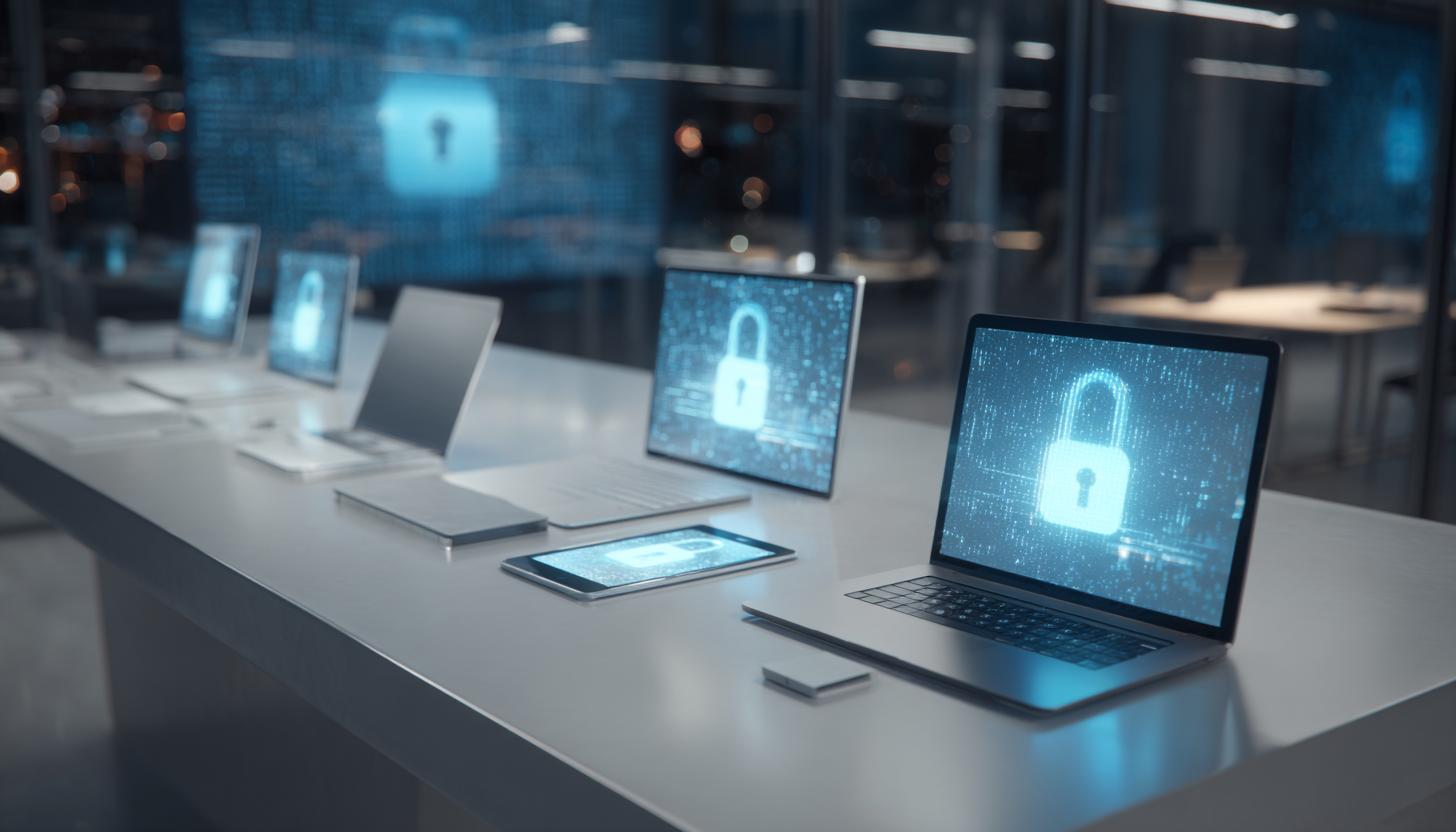
Whether it’s a trade show, rollout, training session, project-based work, field sales campaign, or a pop-up team set up on short notice: Temporary deployments involving laptops, tablets, and smartphones have long been standard practice in everyday B2B operations. At the same time, requirements for data protection, compliance, and reliability are on the rise. This is precisely where the issue of encryption for rental devices becomes particularly relevant. After all, anyone using devices for only a limited period of time needs not only high-performance hardware but also a security strategy that can be quickly implemented, centrally managed, and reliably tracked back to the source.
Modern platforms already come with robust built-in security features: BitLocker on Windows, FileVault on macOS, and device-specific security features on iPhone, iPad, and Android Enterprise devices. However, what matters is not just that encryption is used, but how it is organized in a rental or project context: Who manages recovery keys? What policies apply to temporary users? How are devices returned, wiped, and re-provisioned? And how do you prevent security from slowing down operational pace?
Especially when it comes to leased devices for businesses, the answer is rarely a single tool. Rather, it requires a combination of hardware security features, operating system encryption, MDM/UEM management, clear processes, and professional device preparation. Proper planning in this area significantly reduces risks while ensuring a smooth user onboarding experience—often within just a few hours.
Why Encryption Is Essential for Rented Devices Today
The classic threat is obvious: A device is lost, stolen, or accidentally ends up in the wrong hands. Without full encryption enabled, locally stored data, browser sessions, downloaded reports, offline files, or cached login credentials can lead to a major security incident. With properly configured encryption, this risk is significantly reduced because access to the stored data is made extremely difficult—or practically impossible—without authentication or a recovery key.
In the B2B rental environment, there is an additional layer of complexity: devices change users, locations, and in some cases even countries more frequently. This increases organizational complexity. While processes for permanently assigned company laptops can evolve over months or years, many steps must be in place before delivery in the case of a temporary deployment. This applies in particular to:
- Full encryption enabled before delivery to the user
- Secure storage and segregation of recovery keys
- Defined lockout and password/PIN policies
- Centralized management via MDM, UEM, or Entra/Apple Business environments
- Streamlined return, wipe, and reimaging processes
For companies that only need devices on an occasional basis, partnering with a professional rental provider is therefore often more efficient than spontaneously building their own heterogeneous security infrastructure. This is especially true when a large number of devices need to be ready for use in a very short time—ranging from standard rental laptops to specialized mobile devices.
BitLocker on Windows: The Standard for Professional Laptop Security
BitLocker has been the de facto standard for drive encryption in Windows Professional and Enterprise environments for years. In practice, BitLocker is particularly attractive for temporary Windows deployments because encryption can be easily automated and centrally managed. When combined with TPM 2.0, Secure Boot, and modern management platforms, a device can be fully secured as early as the deployment process.
For leased devices, it is crucial that BitLocker is not only enabled but also integrated into a robust provisioning process. This includes, for example, the automatic escrow storage of recovery keys on a corporate platform, control over the encryption status, and policies for boot protection, PIN usage, and recovery processes.
Of particular relevance in 2026 is the tight integration of Windows security with cloud-based management and identity services. Today, companies expect devices to be deployed using zero-touch or near-zero-touch methods. This means: unbox the laptop, log in, apply policies, and protection is active. For short-term projects, this saves a tremendous amount of time.
In a rental scenario, two questions are also key: First, whether local admin rights remain restricted. Second, who has access to the recovery key. The recovery process, in particular, should never be left to spontaneous improvisation. If a device is suddenly put into recovery mode following a firmware update, hardware replacement, or policy change, it must be clear who provides the key—and how this access is logged.
Office laptops available for rental—which come with a consistent build, up-to-date firmware, and a predefined security baseline—are particularly well-suited for standardized rollouts. When robust business hardware with good remote manageability is required, rental options for devices such as the Lenovo ThinkPad T14 are an obvious choice for many companies.
FileVault on the Mac: Strong Protection for Project Devices and Executive Deployments
FileVault provides full-disk encryption on macOS. Macs are often used on a temporary basis, particularly in creative projects, agency rollouts, the events industry, and management settings. Here, too, the level of security depends entirely on how the organization implements the measures.
FileVault is based on low-level encryption and performs very well in modern Apple environments. Integration with MDM systems and deployments managed through Apple Business Manager is particularly important for businesses. This ensures that devices are already configured to comply with corporate policies during setup and that recovery mechanisms are defined.
In a rental context, a common question regarding Macs is how user accounts are created: local account, managed account, or identity provider-based login. Depending on the project context, it may make sense to use a strictly standardized user profile that is completely removed upon return, after which the device is provisioned anew. This reduces the risk of residual data and simplifies the reuse of the hardware.
A professional rental process for MacBooks or iMacs should therefore take into account FileVault activation, key management, Activation Lock management, and the clear separation of owner and user identities from the outset. Especially with Apple devices, the issue of Activation Lock should not be underestimated, as it can otherwise lead to unnecessary delays during the return process. For computationally intensive creative and production environments, it makes sense to specifically rent a MacBook Pro M1 Max, while for more compact standard setups, renting a 13-inch 2022 MacBook Pro is often perfectly sufficient.
Smartphones and Tablets: Device Protection Goes Beyond Simple Encryption
On iPhones, iPads, and the latest Android business devices, device storage encryption is generally built in by default these days. Nevertheless, in day-to-day business operations, it is not enough to rely solely on the factory settings. What matters most is how the device is managed, assigned, secured, and returned.
In the case of temporary mobile deployments, the following points are particularly important: Device code or strong biometric authentication with a fallback PIN, MDM enrollment, app distribution, containerization of business data, remote lock, Lost Mode, geofencing depending on the use case, and controlled reset before the device is rented out again.
Many customers find it helpful that professional rental companies no longer simply provide mobile devices “as is,” but instead—upon request—deliver them preconfigured with Wi-Fi profiles, email setups, VPN, single-app mode, kiosk mode, or industry-specific apps. Especially at trade shows, promotional events, retail campaigns, or inventory projects, this preparatory work saves a lot of time—and increases security by eliminating the need for ad-hoc user configurations. Those planning iOS-based setups can specifically arrange iPad rentals, either for compact event and POS scenarios or for general use . The rental options include the Apple iPad, available in a 10.2-inch model (7th Generation).
In the smartphone sector, too, choosing the right device category is important. For Apple deployments in sales, VIP support, or corporate communications, rental of an Apple iPhone may be a good option. If the latest high-end models are required, both the iPhone 17 Pro and the Samsung Galaxy S24 are available for rental—for example, for Android Enterprise environments—and can be integrated into a well-managed security framework.
Recovery Keys: The Often-Underestimated Key to Secure Operations
When discussing encryption on leased devices, many people initially focus on enabling the encryption itself. In practice, however, managing the recovery keys is at least as important. After all, strong encryption only provides meaningful protection if companies can continue to legally access their devices in the event of an emergency.
Recovery keys should never be stored in unsecured spreadsheets, unencrypted emails, or locally on the same device. Instead, it is recommended to store them centrally and in a role-based manner within the designated management platforms. Access to keys should be logged, restricted to a small number of authorized personnel, and organizationally separated from the day-to-day operations of end users.
A well-defined escalation process is especially important for short-term projects involving the simultaneous deployment of many devices. If a training room with 40 laptops starts up at 8 a.m. and three devices require a recovery key, the deployment must not come to a standstill. Professional service providers and internal IT teams therefore need clearly defined responsibilities, support windows, and documented approval processes.
| Platform | Encryption Solution | Typical Recovery Approach | Important Considerations for Rented Devices |
|---|---|---|---|
| Windows Laptop | BitLocker | Centralized key storage via corporate or UEM platform | Check TPM status, document the recovery process, and reimage the device after it is returned |
| MacBook / iMac | FileVault | MDM-based key management and recovery procedures | Take Activation Lock into account; clearly separate user assignments |
| iPhone / iPad | Built-in Device Storage Encryption | MDM, Managed Apple IDs, Remote Lock/Wipe | Supervision, Kiosk Mode, Reset, and Logout Before Return |
| Android Enterprise | Integrated Device Storage Encryption | UEM/EMM Management, Work Profile, or Fully Managed | Compliance policies, app control, secure deprovisioning |
Best Practices for Secure Temporary Deployments
When it comes to temporary deployments, one thing matters above all else: standardization. The more individually devices are configured, the greater the risk of security gaps, misconfigurations, and residual data. That’s why modern project environments are increasingly relying on predefined security baselines, automated enrollment processes, and clearly defined decommissioning workflows.
Some of the most important best practices include:
- Enable encryption before delivery: Don’t leave it up to the user; set it as the default in the provisioning process.
- Manage recovery keys centrally and in an audit-proof manner: Access restricted to authorized roles.
- Deploy devices only with the latest firmware and security updates: Especially relevant for large-scale, short-notice rollouts.
- Mandatory use of MDM/UEM: For compliance, app distribution, configuration, and remote management.
- Minimize local data storage: Where possible, use cloud services, virtual desktops, or secure containers.
- Define clear offboarding processes: Lockout, return, inspection routine, deletion, and re-provisioning.
- Segregate usage profiles: Implement different policies for messaging devices, training devices, executives, and field staff as appropriate.
- Maintain documentation and the chain of custody: Who had which device, and when? This is essential for security and liability reasons.
Physical security should not be underestimated, especially in the B2B rental business. Cable locks, privacy filters, rugged transport cases, asset tags, and tamper-resistant logistics processes effectively complement digital device security. After all, an encrypted device is good—but a lost device that results in avoidable reputational damage is still undesirable.
Compliance, Data Protection, and Audit Readiness
By 2026, companies must not only operate in a technically secure manner but also be able to demonstrate it. Data protection requirements, industry-specific regulations, information security standards, and customer requirements increasingly demand traceable processes. For leased devices, this means that the security chain must be documentable—from initial delivery through user assignment to final data erasure or reinstallation.
Areas involving personal data, confidential business information, development data, sales documents, or health and financial information are particularly sensitive. In such scenarios, end-to-end encryption is practically mandatory, but it is only one component. Equally important are access controls, multi-factor authentication, logging, least-privilege principles, and robust data erasure policies.
A professional rental partner can help by not only providing the equipment but also delivering it with predefined security settings. For many IT departments, this is a real relief—especially when internal resources are limited or multiple locations need to be supplied at the same time.
Why Professional Leasing Solutions Are Often Safer Than Ad-Hoc Procurement
At first glance, one might think that security is easier to control on one’s own devices. In reality, however, this is often not the case with short-term projects. When additional hardware must be procured under time pressure, mixed environments quickly emerge—comprising different models, operating system versions, and management statuses. That is precisely when security vulnerabilities arise.
A specialized B2B rental service for technology and mobile devices can offer significant advantages here: standardized device pools, defined deployment processes, experience with large-scale rollouts, preconfigured security policies, and well-established return processes. This is not only operationally efficient but also often improves the actual level of security.
Another benefit for businesses is the ability to request devices on a project-by-project basis, tailored precisely to specific use cases—such as encrypted business laptops for a field service rollout, iPads in kiosk mode for a trade show, or MacBooks for a creative production phase. Those who opt for predictable rental models instead of improvised, ad-hoc solutions gain speed, transparency, and security.
Real-world use cases for rental devices with encryption
Typical scenarios in which the issue of encryption for rental devices is particularly relevant include short-term employee training sessions, seasonal teams, external project groups, event and trade show setups, temporary workstations following hardware failures, international roadshows, and secure executive deployments. Depending on the application, the devices must be secured in different ways.
A laptop used for training often requires strict standardization and quick reinstallation. An iPad used at a trade show should run in kiosk mode and be lockable remotely if lost. A MacBook for management, on the other hand, requires particularly rigorous key management, restrictive policies, and a high level of confidentiality. The goal is always the same: maximum usability with minimal risk.
If your company regularly needs temporary hardware, it’s worth asking not only about the model, screen size, or storage capacity, but also about the security configuration, encryption status, MDM readiness, return process, and support model. This is exactly where simple device deployment differs from a truly professional business solution.
FAQ
Is encryption really necessary for rented devices if they’re only used for a short time?
Yes.Short-term use in particular is often organized in a hectic manner; devices quickly change locations or users, and the risk of loss increases. Full encryption significantly reduces the risk of data leakage.
What is the difference between BitLocker and FileVault?
BitLocker is the full-disk encryption solution for Windows systems, while FileVault is for macOS. Both protect locally stored data but differ in terms of management, integration, and typical deployment processes.
Who should manage recovery keys?
Recovery keys should be managed centrally by authorized IT or security personnel or via appropriate management platforms. End users should generally not have permanent access to all keys.
Is the standard encryption on iPhones and Android devices sufficient?
It serves as an important foundation, but is usually not sufficient for B2B use cases. Additional measures such as MDM/UEM, strong device locks, app control, remote lock/wipe, and defined device return processes are necessary.
How are rented devices securely reset after a project ends?
Ideally, through a standardized deprovisioning process: log out of accounts, remove or reassign administrative profiles, securely delete data, reinstall the operating system, and perform a technical inspection of the device.
Can a rental partner provide devices that are already encrypted and preconfigured?
Yes, that’s exactly what makes sense for many B2B projects. Predefined security policies, enrollment, app setups, and encryption save time and improve consistency during the rollout.
Conclusion
By 2026, BitLocker, FileVault, and mobile device security features will no longer be optional extras but rather the foundation for secure temporary deployments. Anyone who uses laptops, tablets, or smartphones in project, event, training, or rollout contexts should take a holistic approach to the encryption of rental devices: from activation and recovery key management to secure return and refurbishment.
For businesses, this means one thing above all else: security must be fast, scalable, and standardized. That’s exactly why it’s worth partnering with an experienced B2B rental provider who not only supplies hardware but also helps design the appropriate security configuration upon request. If you need temporary mobile devices or business laptops, it’s advisable to address topics such as encryption, MDM, recovery management, and re-provisioning right from the initial inquiry. This transforms a simple device deployment into a robust and professional solution for your entire infrastructure.
Read more - You may also be interested in
Would you like to delve deeper into the topic or discover similar content? Below, we have compiled three additional articles for you that are thematically related to this article. These may also be relevant and interesting for your company.
Leasing Solutions for Businesses
Rental vs. Buying Trade Show and Event Hardware: Costs, Flexibility, and Typical Setups for Businesses
Rental of trade show and event equipment instead of buying it: Cut costs, stay flexible,
Sep
Leasing Solutions for Businesses
Bring-Your-Own-Device vs. Rented Devices: When Each Strategy Is Worth It for Doctoral Programs
BYOD or Rented Devices? 📱 Find out which strategy is best for promotions in 2026—considering
Aug
Leasing Solutions for Businesses
TV/Display Rentals for Trade Show Booths & Events: Resolution, Mounts/Stands, Setup & Data Protection
TV and Display Rentals for Trade Show Booths and Events: Tips on resolution, mounts, stands,
Aug
Guide
Transfer Data Quickly Between PCs Without a USB Drive: Simple Methods for Event Teams
Transfer data quickly between PCs without a USB drive: simple, secure methods for event teams—from
Aug
Technology Trends
EUDI Wallet & Digital Identities: Potential Applications for Check-In, Access Control, and Verification at Events
EUDI Wallet at Events: Digital identities for fast check-in, secure access control, and reliable verification.
Aug
Sustainability
Making Packaging & Logistics Sustainable: Reusable Shipping Containers, Return Shipping Processes, and CO2 Reduction
📦 Making Packaging & Logistics Sustainable: Reusable shipping boxes, efficient return processes, and lower CO₂
Aug

Technology Trends
5G & Alternative Event Internet: Wi-Fi/5G Setup, VoWiFi, and Stratospheric Internet—What’s Realistic?
A Look at Internet for Events in 2026: 5G, Wi-Fi Setup, VoWiFi, and Stratospheric Internet.
Jul
Guide
Secure Wi-Fi on the Go & at Events: Which Smartphone/Hotspot Features You Should Disable and Why
Secure Wi-Fi on the Go & at Events: These Smartphone & Hotspot Features You Should
Jul